1500 RPM to Rad/s: Exact Math & 50 Hz Motor Guide
Convert 1500 RPM to radians per second (50π rad/s). Learn why 4-pole AC motors on 50 Hz European and global power grids operate at this synchronous speed.
If you are reviewing international machinery specifications or working on rotational dynamics problems, converting 1,500 RPM into radians per second is urgent. Trying to derive unit conversions by hand while verifying European motor nameplates is frustrating. The exact conversion for 1500 RPM to rad/s is 50π rad/s, which equals approximately 157.07963 rad/s. Here is the complete engineering breakdown.
The exact conversion for 1500 rpm to rad/s evaluates cleanly to 50π rad/s.
In decimal notation required by engineering simulation software and programmable logic controllers, this calculates to 157.079633 rad/s. You can calculate custom intermediate values using the interactive converter below, or browse our comprehensive table of standard machinery speeds in the conversions directory:
Why 1500 RPM Is the Global 50 Hz Industrial Standard
While North American industrial plants run predominantly on 60 Hz power grids, the vast majority of the world—including Europe, Asia, Africa, and Australia—operates on a 50 Hz electrical infrastructure. Across these territories, 1,500 RPM is the standard synchronous speed for 4-pole AC electric motors.
Standards established by the International Electrotechnical Commission (IEC) define electric motor frame ratings and rotational frequencies across 50 Hz systems. In alternating current induction machines, the synchronous speed of the stator magnetic field depends directly on supply frequency and winding pole pairs.
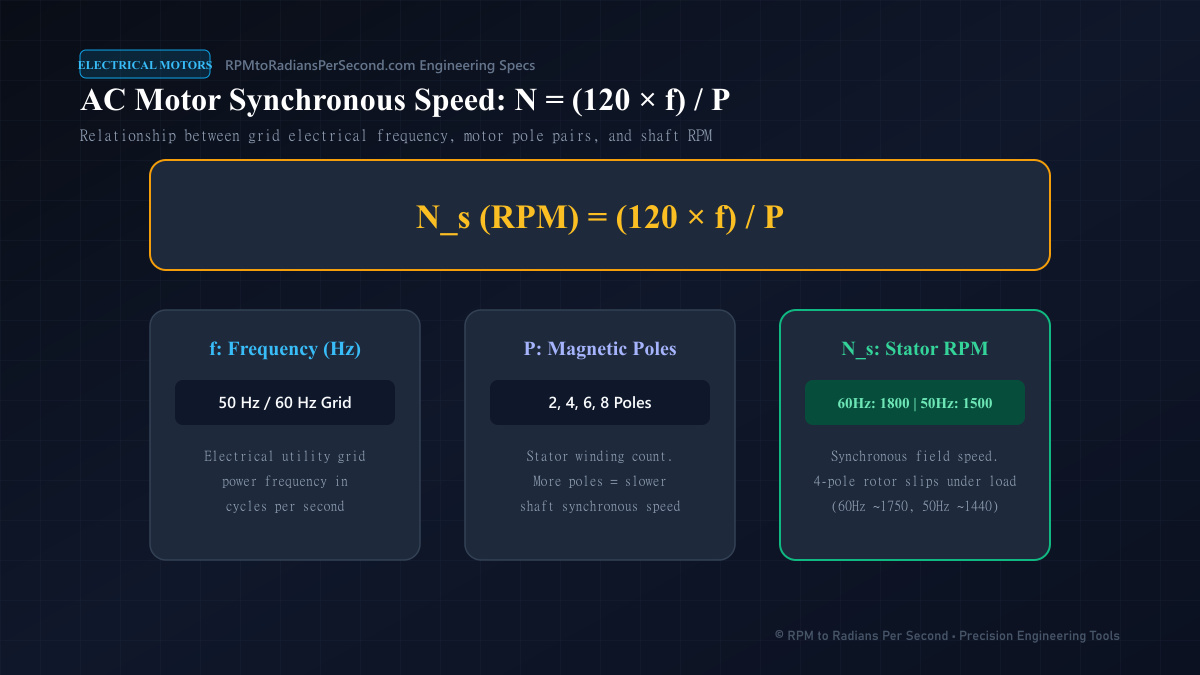
The synchronous speed equation calculates this baseline:
N_s = (120 × f) / p = (120 × 50) / 4 = 1500 RPMWhere:
- f is the electrical line frequency (50 Hz).
- p is the physical quantity of magnetic stator poles (4 poles).
- 120 is the dimensional constant converting seconds to minutes while factoring two pole pairs.
Because a 4-pole stator winding provides optimal torque density and electrical efficiency, 1,500 RPM motors serve as the workhorse for European pumps, compressors, machine tools, and industrial ventilation systems. To compare 50 Hz baselines with 60 Hz standards, consult our guide on standard motor RPMs.
| Motor Standard | Grid Frequency | Operating Condition | Shaft Speed (RPM) | Angular Velocity (rad/s) |
|---|---|---|---|---|
| IEC 4-Pole Synchronous | 50 Hz | Unloaded theoretical baseline | 1,500 RPM | 50π rad/s ≈ 157.08 rad/s |
| IEC Standard Induction Motor | 50 Hz | Full-load nameplate (approx. 3.3% slip) | 1,450 RPM | 48.33π rad/s ≈ 151.84 rad/s |
| NEMA 4-Pole Synchronous | 60 Hz | Unloaded theoretical baseline | 1,800 RPM | 60π rad/s ≈ 188.50 rad/s |
| NEMA Standard Induction Motor | 60 Hz | Full-load nameplate (approx. 2.8% slip) | 1,750 RPM | 58.33π rad/s ≈ 183.26 rad/s |
Step-by-Step Mathematical Derivation
The conversion factor between revolutions per minute and radians per second is π / 30. This conversion standard adheres to the physical definitions published by the International Bureau of Weights and Measures (BIPM) and the NIST Guide to SI Units.
The derivation proceeds through dimensional analysis:
- One revolution encompasses an angular displacement of
2πradians. - One minute encompasses an elapsed time of
60seconds. - Forming the unit cancellation ratio:
(2π rad) / (60 s) = π / 30 rad/s per RPM.
Multiplying this dimensional factor by 1,500 RPM yields:
ω = 1,500 × (π / 30) = (1,500 / 30) × π = 50π rad/sCarrying out the calculation with high-precision decimal π:
50 × 3.1415926535... ≈ 157.079633 rad/sFor complete algebraic proofs and reciprocal conversion mechanics, consult our comprehensive resource on rpm to radians per second.
Peripheral Surface Speed at 1500 RPM
When 1,500 RPM drives a circular saw blade, conveyor roller, or lathe spindle, rotational velocity translates into physical surface speed. Engineers calculate this tangential rim velocity using the fundamental kinematics relation:
v = r × ωWhere:
- v represents linear surface speed in meters per second (m/s).
- r represents component radius in meters (m).
- ω represents rotational velocity in radians per second (rad/s).
Because angular velocity is exactly 50π rad/s, calculating surface speed across common metric pulley and rotor diameters is straightforward:
| Metric Rotating Component | Outer Diameter | Radius (r) | Linear Speed (m/s) | Surface Speed (ft/min) | Velocity (km/h) |
|---|---|---|---|---|---|
| Small Motor Pulley | 100 mm (0.10 m) | 0.05 m | 7.85 m/s | 1,546 SFM | 28.27 km/h |
| Standard Bench Grinder | 200 mm (0.20 m) | 0.10 m | 15.71 m/s | 3,092 SFM | 56.55 km/h |
| Conveyor Drive Roller | 300 mm (0.30 m) | 0.15 m | 23.56 m/s | 4,638 SFM | 84.82 km/h |
| Industrial Blower Wheel | 500 mm (0.50 m) | 0.25 m | 39.27 m/s | 7,730 SFM | 141.37 km/h |
Notice that on a 300 mm conveyor drum spinning at 1,500 RPM, the belt moves at over 23.5 meters per second (nearly 85 km/h). For detailed engineering derivations connecting rim radius directly to travel distance, refer to our guide on rpm to linear velocity.
Frequency and Period at 1500 RPM
To convert 1,500 RPM into rotational frequency in Hertz, divide the rotational speed by 60 seconds:
f = 1,500 RPM / 60 s = 25 HzA shaft rotating at 1,500 RPM completes exactly 25 mechanical revolutions each second. The rotational period required for one single 360-degree rotation is:
T = 1 / f = 1 / 25 s = 0.04 seconds (40 ms)In a 4-pole AC synchronous machine, each mechanical revolution corresponds to two electrical cycles. Multiplying 25 Hz mechanical frequency by 2 pole pairs yields the native 50 Hz electrical waveform. For an in-depth exploration of electrical frequency versus mechanical shaft speed, read our analysis on rpm to hz.
To examine the 60 Hz equivalent speed for 4-pole motors, explore our detailed analysis of 1800 rpm to rad/s.
Code Implementations for Automation Engineers
Industrial automation platforms and simulation tools frequently model international drive systems. Academic course materials, including engineering curriculum published on MIT OpenCourseWare, highlight the necessity of exact constants in digital motor models.
Python Code
import math

def convert_1500_rpm_to_rad_s() -> float:
    rpm = 1500.0
    return rpm * (math.pi / 30.0)

omega = convert_1500_rpm_to_rad_s()
print(f"Angular Velocity: {omega:.6f} rad/s") # Output: 157.079633 rad/s
Structured Text (PLC IEC 61131-3)
VAR
    Motor_RPM : REAL := 1500.0;
    Omega_RadS : REAL;
END_VAR

Omega_RadS := Motor_RPM * (3.14159265 / 30.0);
Frequently Asked Questions
What is 1500 RPM in radians per second?
1500 RPM equals exactly 50π rad/s, which evaluates to approximately 157.079633 radians per second.
Why do European electric motors run at 1500 RPM?
In Europe and other 50 Hz regions, a 4-pole AC motor has a synchronous speed of (120 × 50) / 4 = 1500 RPM. This matches the grid frequency and stator winding configuration.
What is the difference between 1500 RPM and 1450 RPM on a motor?
1,500 RPM is the theoretical synchronous speed of the rotating magnetic field. Under full mechanical load, an induction motor slips by approximately 3.3%, resulting in an actual shaft speed of 1,450 RPM.
What is the linear surface speed of a 200 mm wheel at 1500 RPM?
A 200 mm diameter wheel has a radius of 0.10 meters. Multiplying this radius by 157.08 rad/s gives a surface speed of 15.71 meters per second (approx. 56.55 km/h).
What is the rotational frequency in Hertz for 1500 RPM?
Dividing 1,500 RPM by 60 seconds yields a rotational frequency of 25 Hz. One revolution takes exactly 0.04 seconds (40 milliseconds).
Ready to run the numbers?
Get your result instantly — private, in your browser.