Standard Motor RPMs: AC Synchronous Speeds & rad/s
Standard AC motor RPMs for 50Hz and 60Hz grids. Learn synchronous speed formulas, induction slip, and exact rad/s conversions for motor sizing.
You are staring at a motor catalog, trying to select the right part for your project, and you keep seeing the exact same weird numbers over and over again: 3600, 1800, 1200. Why does every manufacturer seem to agree on these specific, arbitrary RPMs? And more importantly, how do you quickly translate those catalog numbers into the angular velocity you actually need for your physics and control equations?
Do not panic. Those numbers are not arbitrary; they are dictated by the laws of electromagnetism and the frequency of the power grid you are plugged into.
Below, we have broken down exactly where these standard motor RPMs come from, and we have provided a clean lookup table for their exact rad/s equivalents. You can also browse all speeds in our complete conversion index.
The Synchronous Speed Formula
When calculating the standard rpm for motors, the rotational speed is permanently tied to two physical parameters: grid frequency (60 Hz in North America or 50 Hz in Europe) and magnetic pole count. This standard is governed internationally by bodies like the International Electrotechnical Commission (IEC).
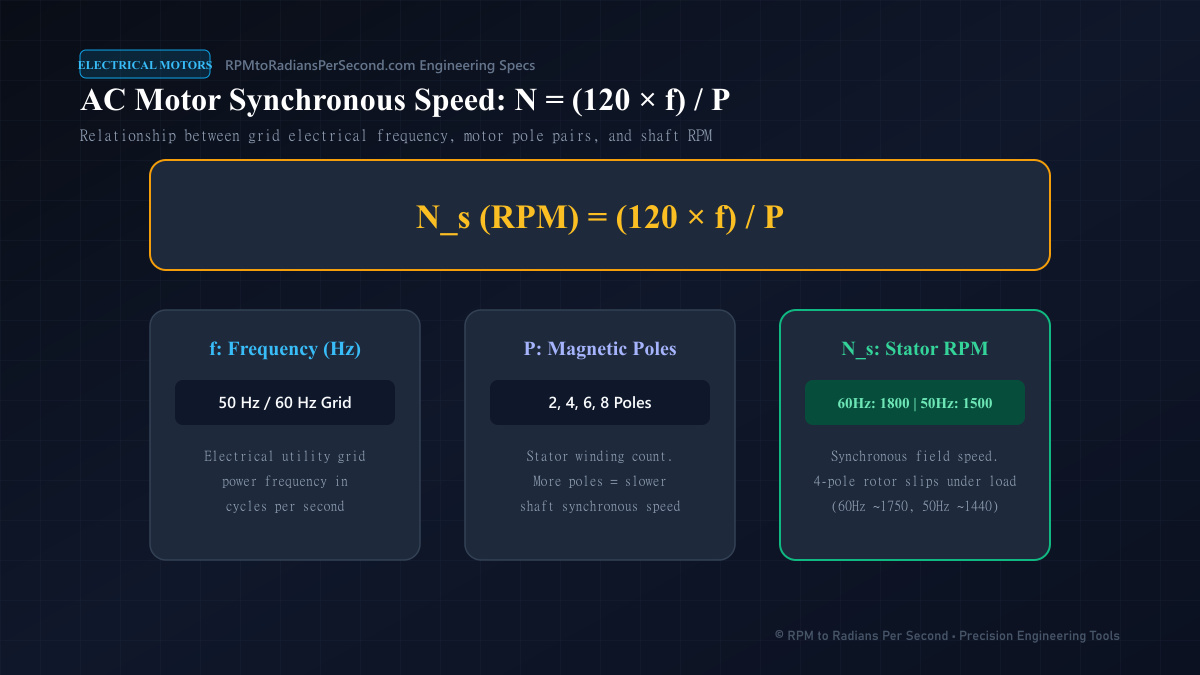
The formula for synchronous speed is:
Synchronous Speed (RPM) = (120 × Frequency) / Number of PolesBecause motor poles must exist in pairs (you cannot have a north pole without a south pole), the number of poles must be an even integer: 2, 4, 6, 8, etc. When you plug a 60 Hz grid frequency and an even number of poles into that formula, it spits out the standard RPM catalog speeds you see everywhere. If you know the grid frequency, you can easily convert rpm to angular velocity in radians per second.
Standard 60 Hz Motor Speeds (North America)
If you are working with a standard 60 Hz power supply, which is standard in North America as noted by the U.S. Department of Energy (DOE), these are the synchronous speeds you will encounter, along with their exact conversion to angular velocity using the RPM × π/30 multiplier.
Notice how a 60-pole motor would produce exactly 120 RPM (read our dedicated 120 RPM guide).
Standard 50 Hz Motor Speeds (Europe, Asia, etc.)
If your equipment is running on a 50 Hz grid, the motor spins a bit slower. Here are the standard speeds and their angular velocities.
Quantifying Induction Motor Slip
To accurately model drivetrain dynamics, engineers calculate the exact slip percentage using nameplate data:
Slip (%) = ((Synchronous RPM - Actual RPM) / Synchronous RPM) × 100For a standard 4-pole motor operating at 1,750 RPM on a 60 Hz grid:
- Synchronous speed: 1,800 RPM
- Actual rotor speed: 1,750 RPM
- Slip calculation:
((1800 - 1750) / 1800) × 100 = 2.78%
Higher-efficiency motors typically exhibit lower slip percentages (around 1.5% to 3%), whereas high-starting-torque NEMA Design D motors can have slip values exceeding 8%. This slip represents the exact relative speed at which the rotor conductors cut the stator's rotating magnetic flux lines, generating induced rotor current.
Bypassing Standard Speeds with Variable Frequency Drives (VFDs)
In modern automation, machinery often requires non-standard speeds that fall outside fixed grid poles. Instead of using mechanical variable-speed pulleys, engineers install Variable Frequency Drives (VFDs).
A VFD rectifies incoming AC utility power into direct current, then uses pulse-width modulation (PWM) through insulated-gate bipolar transistors (IGBTs) to reconstruct synthetic AC power at any commanded frequency from 1 Hz to 120 Hz or higher.
When driven by a VFD at 90 Hz, a standard 4-pole motor that normally spins at 1,800 RPM runs at:
(120 × 90 Hz) / 4 = 2,700 RPM(synchronous)- Angular velocity:
2700 × (π/30) = 90π ≈ 282.74 rad/s
However, operating standard motors above base grid frequency reduces available torque because the inverter enters the "constant horsepower / field-weakening" regime. When pairing your motor with gearboxes, evaluate gear reduction ratios to properly match required output torque with drive capability.
Zero-Slip Synchronous Motors: PMSM and SynRM Technology
While AC induction motors remain the most widespread industrial prime movers, high-efficiency applications increasingly deploy Permanent Magnet Synchronous Motors (PMSMs) and Synchronous Reluctance Motors (SynRMs).
Unlike induction motors, which require rotor slip to induce magnetic current, a PMSM features neodymium magnets embedded directly within the rotor. These magnets lock synchronously with the stator's rotating magnetic field.
Consequently, a PMSM exhibits exactly 0.00% slip:
- An 8-pole PMSM powered by a 60 Hz drive rotates at exactly 900.00 RPM from no-load up to full rated torque.
- The physical angular velocity is precisely 30π rad/s (94.2478 rad/s) without variation.
- This absolute speed repeatability makes synchronous motors ideal for multi-axis conveyor synchronization, precision metering pumps, and electric vehicle traction drives.
Low-Speed Thermal Derating: Why Slowing Down Overhead Motors Overheats Them
When engineers slow a standard totally enclosed fan-cooled (TEFC) induction motor from 1,800 RPM down to 300 RPM using a VFD, they often overlook thermal cooling limitations.
The motor's cooling fan is mounted directly to the main shaft. Because cooling airflow varies with the cube of shaft speed (), reducing motor speed to 300 RPM (16.7% of base speed) reduces cooling air volume by over 99.5%!
Without adequate airflow, the stator windings rapidly overheat even when drawing normal rated current. Under the guidelines of NEMA MG-1 Part 31, inverter-rated motors operated at continuous low speeds must be equipped with auxiliary constant-speed electric blowers or derated to prevent premature winding burnout.
Drivetrain Integration and Sizing
Now that you know the underlying math of the grid, catalog numbers look straightforward. Sizing motor drives requires balancing rotational frequency, torque, and power.
When sizing a motor to drive mechanical loads, remember that shaft torque and speed dictate your usable work. Explore our rpm and torque to horsepower calculator to evaluate motor sizing in HP or kW.
If the motor drives a conveyor, roller, or drive wheel, use our rpm to linear velocity guide to calculate surface speed.
Frequently Asked Questions
1. Why do I see 1750 RPM instead of 1800 RPM on my motor?
1800 RPM is the synchronous speed (the speed of the magnetic field). 1750 RPM is the "nameplate" or full-load speed. The difference between the two is called "slip," which is necessary for an induction motor to produce torque.
2. How do grid frequencies affect motor RPM?
An AC motor's speed is directly proportional to the grid frequency. A motor designed for a 60 Hz grid will spin 20% faster than it would if plugged into a 50 Hz grid.
3. Can I run a 50Hz motor on a 60Hz grid?
Generally, yes, but it will spin 20% faster, which may alter the cooling dynamics and torque output. You must always check the manufacturer's datasheet before running a motor off-frequency.
4. What is the formula for synchronous speed?
The formula is (120 × Frequency) / Number of Poles.
5. Are DC motors limited to these standard RPMs?
No. Because DC (direct current) motors do not rely on the alternating frequency of the power grid, they can be designed to spin at virtually any RPM by adjusting the voltage or internal windings.
Need to convert a strange nameplate RPM to rad/s? Don't guess the conversion factor. Use our free interactive calculator to calculate exact angular velocities and linear speeds for any motor on the market.
Ready to run the numbers?
Get your result instantly — private, in your browser.