The RPM to Radians Per Second Formula: How to Calculate
Master the rpm to radians per second formula (π/30). Learn why it works and how to apply it without rounding errors in physics and engineering equations.
Staring at a motor specification and realizing you need to plug it into a complex kinematics equation doesn't have to be a nightmare. Human brains do not naturally process rotations in radians, but the math requires it. We need the exact formula to convert revolutions per minute into a standard angular velocity so we know our final calculations are airtight.
The math to figure this out is straightforward. The exact rpm to radians per second formula is:
rad/s = RPM × (π / 30)Want to skip the derivation and just get your answer? Drop your RPM into the calculator below, or jump directly to pre-calculated speeds like 1,750 RPM, 3,000 RPM, or 3,600 RPM in our conversion index.
The Algebraic Proof: Dimensional Cancellation of Units
The multiplier π/30 is not an empirical fudge factor. It is the exact mathematical reduction of dimensional unit cancellation codified by the Bureau International des Poids et Mesures (BIPM) and the NIST Guide to SI Units.
To translate a rotational rate from mechanical cycles into coherent SI angular frequency, two conversions must occur simultaneously:
- Rotational Displacement: One full revolution sweeps through 360 degrees of planar angle. By definition of circular arc subtension, 360 degrees corresponds to exactly 2π radians. Therefore, multiply by
(2π rad / 1 rev). - Temporal Basis: Rotational tachometers sample frequency per minute. The SI base unit for time is the second. Because one minute contains 60 seconds, divide by
(60 s / 1 min).
Multiplying these continuous transformation ratios yields:
ω (rad/s) = (RPM rev / 1 min) × (2π rad / 1 rev) × (1 min / 60 s) = RPM × (2π / 60)Factoring out the greatest common divisor of 2 from the numerator and denominator simplifies 2π / 60 to its irreducibly exact form:
rad/s = RPM × (π / 30) ≈ RPM × 0.10471975511965977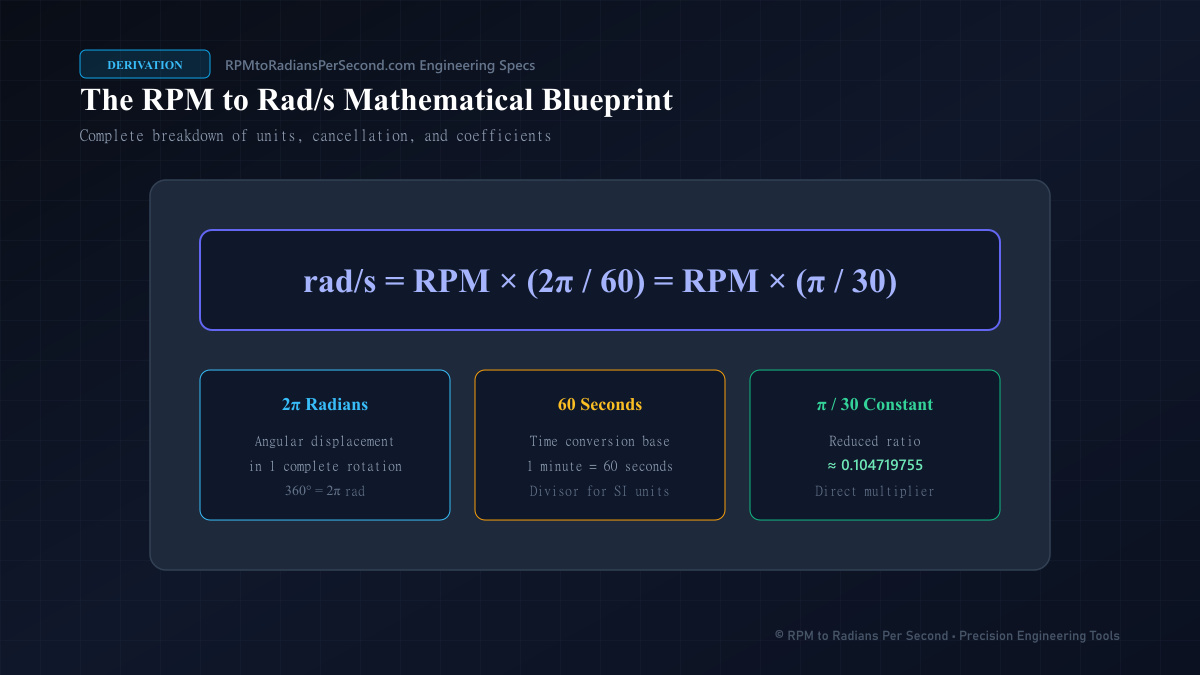
How to Apply the Formula (With Examples)
Let's look at the numbers in a real-world scenario. Let's say you have an electric motor spinning at 1,500 RPM.
- Start with your RPM: 1,500
- Multiply by π/30:
1500 × (π/30) - Reduce the fraction:
1500 / 30 = 50 - Final Exact Answer:
50π rad/s
If you punch that into a calculator, 50 × π is approximately 157.079 rad/s. You can use this same logic for any speed, whether it is an industrial turbine or 120 rpm to radians per second.
Why Calculus Demands the Radian: The Limit Proof
Students frequently ask why physics professors forbid using degrees per second in differential calculus. The requirement stems from the fundamental geometric limit of trigonometry.
In introductory calculus, the derivative of the sine function is proven using the difference quotient:
d/dx [sin(x)] = lim (h → 0) [sin(x + h) - sin(x)] / h = cos(x) · lim (h → 0) [sin(h) / h]The limit lim (h → 0) [sin(h) / h] equals exactly 1 if and only if the angle is measured in radians. If angle is measured in degrees, the limit evaluates to π / 180 ≈ 0.017453:
d/dx [sin_deg(x)] = (π / 180) · cos_deg(x)If mechanical formulas used degrees per second or RPM directly:
- Every time derivative would spawn parasitic multiples of
π / 180. - The second derivative for acceleration would inherit
(π / 180)² ≈ 0.0003046. - Harmonic oscillator wave equations () would become hopelessly cluttered with conversion constants.
By using the rpm to radians per second formula, angular frequency () integrates and differentiates cleanly without scaling artifacts, as established in standard physics texts hosted on MIT OpenCourseWare.
Euler's Formula and Harmonic Oscillations: Exp(i · ω · t)
In electrical engineering and structural vibration analysis governed by the IEEE Standards Association, rotating machinery is modeled using complex exponential phasors:
x(t) = A · e^(i · ω · t) = A · [cos(ω · t) + i · sin(ω · t)]This relationship (Euler's identity) only holds true when is expressed in radians per second. The power series expansion of the exponential function:
e^(i · ω · t) = 1 + i·ω·t - (ω·t)² / 2! - i·(ω·t)³ / 3! + ...Requires that the exponent (i · ω · t) be a pure, dimensionless scalar. Because the radian is a dimensionless ratio of arc length to radius (meters / meters), the product (rad/s × s) evaluates to a pure number. If RPM were used, the exponential expansion would be dimensionally invalid.
Quick Reference Conversion Table
Here is how the formula plays out across common mechanical speeds, ranging from clock hands to standard motor RPMs. Notice how the exact rad/s retains the π factor for absolute mathematical accuracy.
| Motor Speed (RPM) | Exact Multiplier | Exact rad/s | 6-Digit Decimal | Harmonic Frequency (Hz) |
|---|---|---|---|---|
| 1 RPM | 1 × (π/30) | π / 30 | 0.104720 | 0.016667 Hz |
| 60 RPM | 60 × (π/30) | 2π | 6.283185 | 1.000000 Hz |
| 120 RPM | 120 × (π/30) | 4π | 12.566371 | 2.000000 Hz |
| 1,800 RPM | 1,800 × (π/30) | 60π | 188.495559 | 30.000000 Hz |
| 3,600 RPM | 3,600 × (π/30) | 120π | 376.991118 | 60.000000 Hz |
| 10,000 RPM | 10,000 × (π/30) | 1,000π / 3 | 1,047.197551 | 166.666667 Hz |
Notice how 60 RPM and 120 RPM produce whole-integer multiples of π. For slow drives, see our 1 rpm to radians per second analysis.
Small-Angle Linearization: Taylor Series Approximations
In robotics state estimators and Kalman filters, computing full trigonometric functions on every clock cycle is computationally prohibitive. Engineers frequently apply the small-angle approximation:
sin(θ) ≈ θ - θ³ / 6 + θ⁵ / 120 ≈ θ (for small θ)This foundational linearization is only valid when is expressed in radians. If rotational velocity is maintained in RPM, evaluating displacement across a 1-millisecond sensor sample (time step dt = 0.001 s) requires converting RPM into radians per second first.
Plugging degrees or raw RPM into the small-angle approximation causes the Taylor series polynomial to diverge wildly. By converting RPM directly to rad/s using π/30, the linear approximation retains an error below 0.01% for angles up to 0.14 radians, allowing embedded flight controllers to stabilize rapidly.
Software Engineering Implementation: Preserving Precision
When implementing the rpm to radians per second formula in software, avoid calculating pi / 30.0 inside high-frequency real-time loops. Pre-evaluate the conversion factor as a 64-bit IEEE 754 double precision constant:
Python 3 Implementation
import math

# Exact precomputed constant: pi / 30
RADS_PER_RPM: float = math.pi / 30.0

def rpm_to_rad_s(rpm: float) -> float:
    """Converts RPM to rad/s preserving 64-bit IEEE 754 precision."""
    if rpm < 0:
        raise ValueError("Rotational speed cannot be negative.")
    return rpm * RADS_PER_RPM

# Example: 1,800 RPM synchronous motor speed
print(f"Angular speed: {rpm_to_rad_s(1800):.10f} rad/s")
C / C++ Embedded Firmware Pattern
#include <stdio.h>

// Pre-evaluated 64-bit double: pi / 30 (24 decimal digits)
static const double K_RPM_TO_RADS = 0.104719755119659774615421;

double convert_rpm_to_rad_per_sec(double rpm) {
    return rpm * K_RPM_TO_RADS;
}
Numerical Integration Stability in Physics Engines
In modern dynamic simulation software (such as MuJoCo, Bullet Physics, or Open Dynamics Engine), rotational orientation is updated at each discrete time step (dt):
θ(t + dt) = θ(t) + ω(t) · dtIf the physics engine converts motor telemetry using a rounded constant like 0.10472, a cumulative integration error of +0.000244 rad/s enters every state update.
At a 1,000 Hz physics sampling rate, this truncation error accumulates over 878 radians (more than 139 full uncommanded revolutions) over a single 24-hour simulation cycle! Maintaining full floating-point precision prevents orientation quaternions from drifting over time.
For inverse calculations translating simulation velocity vectors back into mechanical shaft speeds, consult our radians per second to rpm formula.
Frequently Asked Questions
1. What is the rpm to radians per second formula?
The universally accepted formula is rad/s = RPM × (π / 30). Multiply your RPM value by and divide by 30 to get exactly the number of radians per second.
2. Why is the conversion factor π/30?
The factor comes from combining two physical steps: multiplying by (to convert revolutions to radians) and dividing by 60 (to convert minutes to seconds). The fraction reduces to .
3. How do you convert rpm to radians per second without a calculator?
For a quick mental estimate, divide your RPM by 10. Because , dividing by 10 yields a rapid approximation with approximately 4.7% error:
| Speed (RPM) | Quick Mental Math (/10) | Exact Calculator Math (π/30) | Difference |
|---|---|---|---|
| 1,500 RPM | 150 rad/s | 157.08 rad/s | ~7 rad/s error |
| 3,000 RPM | 300 rad/s | 314.16 rad/s | ~14 rad/s error |
| 10,000 RPM | 1,000 rad/s | 1,047.20 rad/s | ~47 rad/s error |
4. What is the formula for calculating linear velocity from RPM?
First use the formula to find angular velocity , then multiply by the radius in meters (). For full derivations, see our rpm to linear velocity guide.
Don't let rounded constants degrade your engineering simulations. Try our interactive RPM to rad/s calculator to compute exact fractional formulas, decimal expansions, and rotational kinematics metrics with complete mathematical accuracy.
Ready to run the numbers?
Get your result instantly — private, in your browser.