How to Use the RPM to Radians Per Second Calculator
A complete engineering guide to the RPM to radians per second calculator. Generate exact symbolic math, linear surface speeds, and frequency metrics.
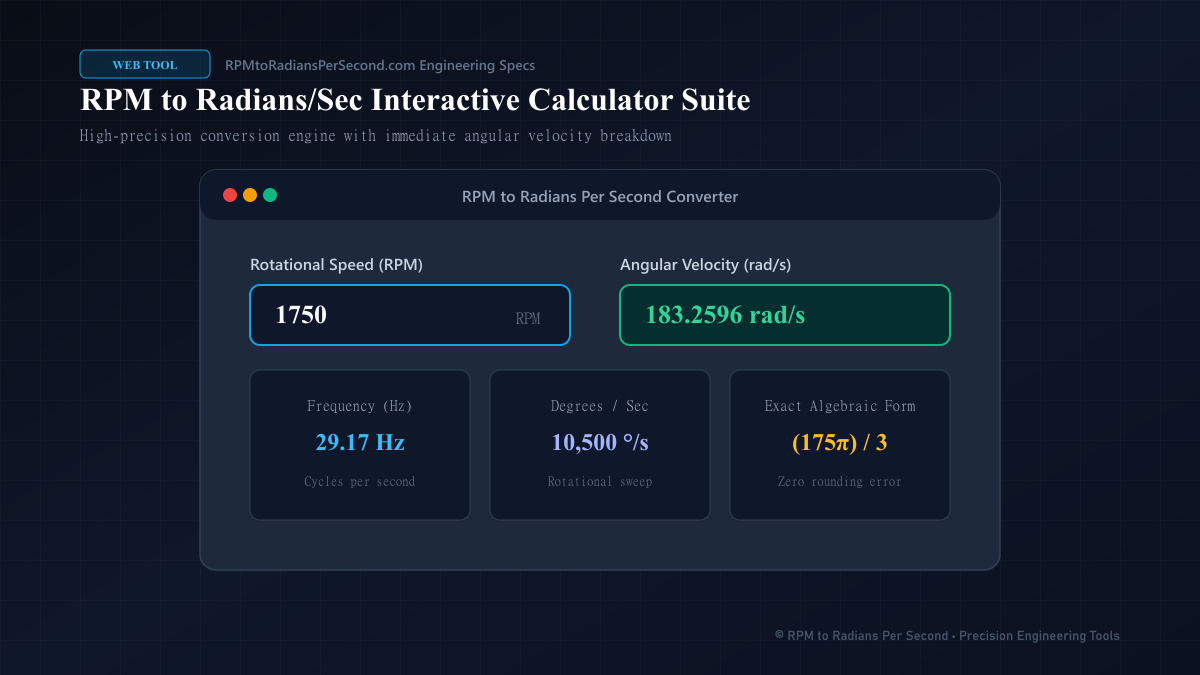
You are staring at a massive dataset of motor speeds, dynamometer test logs, or physics homework problems, and you cannot afford to manually calculate π/30 hundreds of times. Calculating manual conversions by hand invites human fatigue, decimal transcription errors, and failed design audits. We built our interactive RPM to radians per second calculator to deliver instant, floating-point precision with symbolic algebraic fractions and linear kinematics support.
Try the interactive version of our RPM to radians per second calculator right here, or explore pre-calculated figures like 3,600 RPM to rad/s in our complete conversion index:
Why Modern Engineering Demands a Dedicated Calculator
When engineers perform hand calculations on scratchpads, it is tempting to use rounded decimals like 0.10472 instead of the exact fraction π / 30. While that shortcut seems acceptable for quick sanity checks, rounding errors compound aggressively across multi-stage drivetrains.
According to measurement protocols codified by the National Institute of Standards and Technology (NIST), derived rotational metrics require full decimal preservation. Furthermore, software simulation environments must adhere to the IEEE 754 Standard for Floating-Point Arithmetic to prevent rotational drift in numerical integrators.
Our computational engine evaluates calculations using double-precision 64-bit IEEE floats, preserving symbolic π representation until the final rendering step.
| Calculation Method | 3,000 RPM Output | Error Percentage | Engineering Impact |
|---|---|---|---|
| Exact Fraction (π/30) | 100π (314.159265 rad/s) | 0.0000% | Zero mathematical drift in robotics and aerospace simulations. |
| Rounded Decimal (0.10472) | 314.160000 rad/s | +0.0002% | Minor error for homework, causes cumulative drift in CAD animation. |
| Mental Shortcut (/10) | 300.000000 rad/s | -4.5070% | Catastrophic error; only suitable for coarse ballpark checks. |
Our software evaluates the exact rpm to radians per second formula under the hood, ensuring your simulation scripts and hardware specifications remain completely reliable.
Core Features and Advanced Capabilities
Beyond converting basic rotational frequency into rad/s, our calculator provides an integrated multi-physics toolset for mechanical engineers:
1. Symbolic Pi Multiples
Textbook physics exams and university mechanics courses frequently require exact symbolic answers rather than long decimals. If you enter 1,800 RPM, the tool immediately displays 60π rad/s. This allows you to cancel terms cleanly in subsequent algebraic derivations without reaching for scratch paper.
2. Tangential Linear Velocity Integration
By entering the rotating object's radius in meters, centimeters, or inches, the tool executes the tangential velocity equation (). It provides simultaneous readouts in meters per second (m/s), kilometers per hour (km/h), and miles per hour (mph). To explore this relationship across varying wheel sizes, review our dedicated rpm to linear velocity guide.
3. Harmonic Frequency and Period Output
Rotational machinery interfaces directly with AC electrical equipment and vibration sensors. The tool computes cyclic frequency in Hertz () and cycle period in milliseconds (). For a detailed exploration of alternator poles and acoustic orders, visit our rpm to hz conversion guide.
| Generated Quantity | Defining Formula | Primary Application |
|---|---|---|
| Angular Velocity (rad/s) | ω = RPM × (π / 30) | Kinematic solvers, momentum, and motor sizing. |
| Cyclic Frequency (Hz) | f = RPM / 60 | AC generator grids, acoustic vibration analysis. |
| Rotation Period (ms) | T = 60,000 / RPM | Stroboscope timing, encoder pulse intervals. |
| Angular Speed (°/s) | deg/s = RPM × 6 | Robotic joint trajectory visualization. |
| Surface Speed (m/s) | v = r × (RPM × π/30) | Conveyor belts, vehicle tires, cutting discs. |
3 Practical Engineering Workflows
Here is how mechanical designers and software engineers incorporate our calculator into real-world projects:
Workflow 1: Sizing Servomotors for Robotic Arms
When designing a robotic manipulator, the inverse kinematics solver computes trajectory velocities in rad/s. However, industrial servos from vendors like Omron or Yaskawa are ordered by RPM.
- Compute your trajectory requirements: e.g., 25 rad/s joint swing.
- Use our reverse radians per second to rpm logic to find the catalog requirement:
25 × (30 / π) = 238.7 RPM. - Select an off-the-shelf 3,000 RPM servomotor paired with a high-precision gearbox using our gear ratio rpm calculator.
Workflow 2: Machining Surface Footage (SFM to RPM)
CNC machinists operating vertical mills must calculate the exact spindle speed required to maintain the recommended surface feet per minute (SFM) for a carbide end mill:
- Tool diameter: 0.50 inches (radius = 0.00635 m)
- Target surface speed: 3.14 m/s (approx 600 SFM)
- Inputting the dimensions into our calculator reveals that a spindle speed of 4,720 RPM delivers the exact tangential velocity required to prevent tool chatter and premature wear.
Workflow 3: Powertrain Torque and Dyno Analysis
Automotive dynamometers record engine torque across varying crankshaft speeds. Because power is defined physically as torque multiplied by angular velocity (), our calculator allows engine tuners to verify dyno software calibration. To evaluate brake horsepower and kilowatts across your engine's powerband, check our rpm and torque to horsepower calculator.
According to standards maintained by the Bureau International des Poids et Mesures (BIPM), derived mechanical power equations require coherent SI radians to ensure unit consistency.
Frequently Asked Questions
1. How does the RPM to rad/s calculator work?
The calculator multiplies your entered RPM value by the exact mathematical fraction π / 30 (approximately 0.104719755). It simultaneously computes cyclic frequency in Hertz (RPM ÷ 60) and period in seconds (60 ÷ RPM).
2. Can the calculator compute linear speed?
Yes. By providing the radius of your rotating wheel or shaft in the optional radius field, the tool applies v = r × ω to compute linear surface velocity in meters per second (m/s), kilometers per hour (km/h), and miles per hour (mph).
3. Why does the calculator show exact multiples of Pi?
Exact Pi multiples eliminate rounding errors in academic and engineering calculations. Carrying symbolic Pi (such as 100π rad/s) through multi-stage equations guarantees total algebraic precision until your final numerical output.
4. How do I convert rad/s back into RPM?
To reverse the calculation, multiply your radians per second value by the reciprocal fraction 30 / π (approximately 9.54929658).
5. Does the calculator handle fractional or decimal RPM inputs?
Yes. Our engine accepts arbitrary decimal inputs, such as 33.333 RPM for audiophile vinyl turntables or 0.5 RPM for industrial rotary kilns. The calculation algorithm processes floating-point decimals with double-precision IEEE-754 mantissas to avoid precision loss.
6. What is the difference between rotational frequency and angular velocity?
Rotational frequency measures full revolutions completed per unit of time (such as revolutions per minute or Hertz). Angular velocity measures the continuous rate of change of the swept central angle in radians per second. Because one complete revolution encompasses 2π radians, angular velocity is always 2π times the frequency in Hertz.
Need to convert multiple motor speeds or verify your kinematic equations? Explore our complete collection of engineering guides to instantly compute exact π-based answers, decimal approximations, and linear velocities for any rotating mechanism.
Ready to run the numbers?
Get your result instantly — private, in your browser.