120 RPM to Radians Per Second: Exact Math & Guide
Find the exact conversion for 120 RPM to radians per second (4π rad/s). Learn why this specific speed is so common in AC motors and physics problems.
If you are frantically Googling this specific number in the middle of an exam or while reading a motor datasheet, let's cut right to the chase. You don't have time to derive the formula from scratch. You just need the answer so you can plug it into your angular velocity equation and move on to the next step.
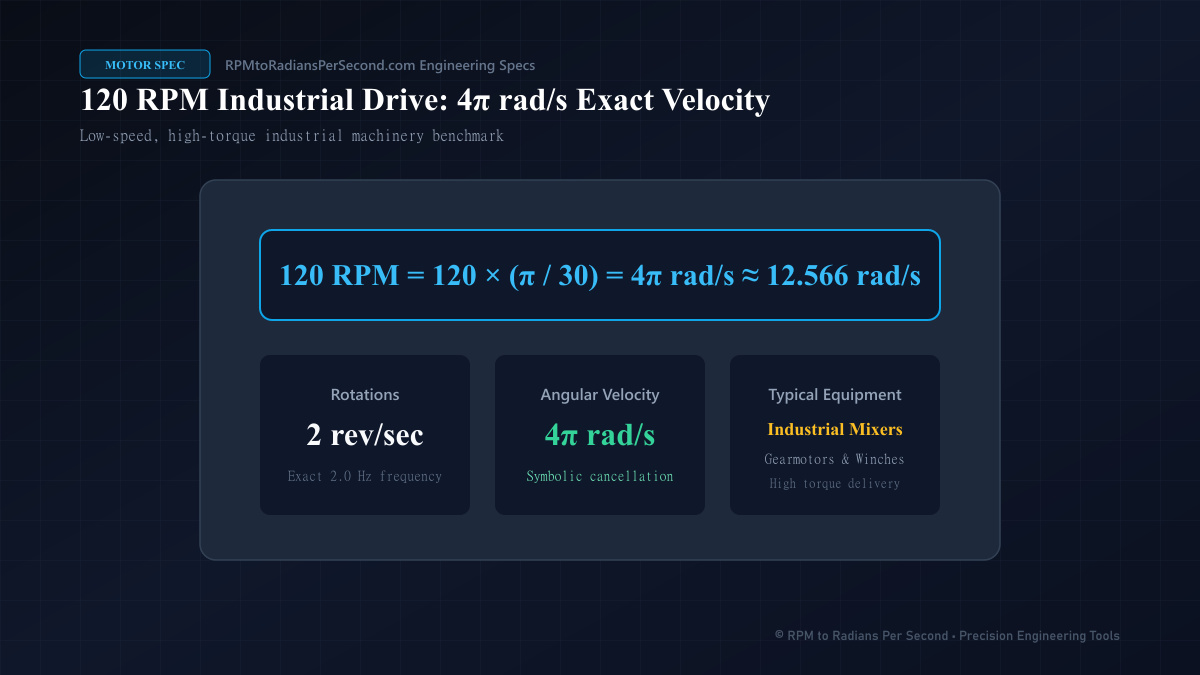
The exact conversion for 120 rpm to radians per second is 4π rad/s.
If your software or calculator demands a decimal, that is approximately 12.56637 rad/s. You can verify this using the calculator below, or view all speeds in our conversions directory:
Why are you searching for 120 RPM?
It is not a coincidence that so many engineering students and professionals search for this specific conversion. 120 RPM is not just a random textbook number; it is deeply tied to the way the global electrical grid operates.
If you are dealing with AC (alternating current) motors—specifically synchronous motors running on a standard 60 Hz power grid, as defined by organizations like the IEEE—the speed of the motor is dictated by the grid frequency and the number of magnetic poles in the motor. You can explore more about this in our guide on standard motor RPMs.
The formula for synchronous speed is (120 × Frequency) / Poles.
For a very common 60-pole low-speed synchronous motor, the math spits out exactly 120 RPM. Because it is such a standard real-world speed used in heavy industrial equipment, physics professors love to use it in kinematics and torque problems.
| Application | Why 120 RPM? |
|---|---|
| Large Industrial Fans | Slow, steady rotation moves large volumes of air efficiently without excessive noise. |
| Water Treatment Mixers | Ideal for slow agitation of chemicals without creating turbulent splashing. |
| Rotary Kilns | The low speed provides enough time for materials to heat evenly as they tumble. |
The Math Behind the 120 RPM Conversion
If you need to show your work on a test, here is exactly how we arrived at 4π rad/s.
To convert rotational speed to angular velocity, the universally accepted mathematical multiplier is π/30. This is the standard taught in mechanics courses, such as those freely available on MIT OpenCourseWare and documented in the NIST Guide to SI Units.
- Start with your speed: 120 RPM
- Multiply by the conversion factor:
120 × (π / 30) - Simplify the fraction:
120 / 30 = 4 - The final exact result: 4π rad/s
Formula Check:
rad/s = 120 × (π / 30) = 4π ≈ 12.56637 rad/sLinear Surface Velocity at 120 RPM
In conveyor engineering and material handling, rotational speed at 120 RPM frequently drives drive pulleys and traction rollers. To find the physical travel speed of the belt or rim, apply the linear velocity formula v = r × ω.
Because angular velocity is exactly 4π rad/s, calculating surface velocity across different roller diameters is straightforward:
| Roller Diameter | Roller Radius (r) | Angular Velocity (ω) | Exact Linear Velocity (v) | Decimal Velocity (m/s) | Surface Speed (km/h) |
|---|---|---|---|---|---|
| 0.20 meters | 0.10 m | 4π rad/s | 0.4π m/s | 1.257 m/s | 4.52 km/h |
| 0.50 meters | 0.25 m | 4π rad/s | 1.0π m/s | 3.142 m/s | 11.31 km/h |
| 1.00 meters | 0.50 m | 4π rad/s | 2.0π m/s | 6.283 m/s | 22.62 km/h |
Notice that on a 0.5-meter diameter pulley, the surface travel speed is exactly π meters per second! If your project requires adjusting wheel sizes or travel speeds, explore our rpm to linear velocity calculator.
Gear Reduction: Stepping Down to 120 RPM
Standard 4-pole industrial induction motors spin at roughly 1,800 RPM (synchronous). When your process demands high torque at 120 RPM, you need a speed reducer.
To determine the required speed reduction:
- Motor Speed: 1,800 RPM
- Target Output: 120 RPM
- Gear Ratio:
1,800 / 120 = 15:1
A 15:1 gearbox steps the rotational speed down to 120 RPM while magnifying the delivered output torque by a factor of 15 (minus frictional losses). You can model different pinion and gear configurations using our gear ratio rpm calculator. To verify how this torque multiplication impacts mechanical work, check our rpm and torque to horsepower guide.
Related 120 RPM Conversions
If you are already converting to rad/s, you might need these related figures to finish your datasheet or assignment. If you ever need to go backwards, check the radians per second to rpm formula.
| Measurement | Value for 120 RPM | How to Calculate |
|---|---|---|
| Hertz (Hz) | 2 Hz | Divide 120 RPM by 60. |
| Rotation Period | 0.5 seconds | Divide 60 seconds by 120 RPM. |
| Degrees per Second | 720° / s | Multiply 4π rad/s by 180/π. |
If your system connects to frequency sensors, review our rpm to hz conversion breakdown.
Multiples of 120 RPM
Because 120 RPM is a clean 4π rad/s, multiples of this speed remain mathematically elegant. This relationship is incredibly useful when dealing with gear cascades or variable speed drives.
| RPM | Multiplier | Exact rad/s | Approx rad/s |
|---|---|---|---|
| 120 | 1x | 4π | 12.566 |
| 240 | 2x | 8π | 25.133 |
| 360 | 3x | 12π | 37.699 |
| 480 | 4x | 16π | 50.265 |
Now you know the answer, the math behind it, and exactly why your professor or engineer chose this specific number. Plug that 4π rad/s into your equations and crush the rest of the problem.
Frequently Asked Questions
1. What is 120 RPM in rad/s exact form?
In exact mathematical form, 120 RPM is equal to 4π rad/s. You achieve this by multiplying 120 by π/30.
2. Why is 120 RPM a common number in physics problems?
120 RPM is the synchronous speed of a 60-pole AC motor running on a standard 60 Hz electrical grid (common in North America). Because it reduces nicely to 4π, professors use it to test if students are carrying exact values through their algebra.
3. What is 120 RPM in Hertz?
120 RPM is exactly 2 Hz. Hertz measures revolutions per second, so you simply divide the RPM (120) by 60 seconds.
4. How do I show my work for converting 120 RPM to rad/s?
Write out the formula: rad/s = RPM × (π / 30). Then substitute the value: rad/s = 120 × (π / 30). Finally, show the fraction reducing: 120/30 = 4, leaving you with 4π.
5. What if my calculator doesn't have a Pi button?
If you absolutely must use a decimal and lack a Pi button, use 3.14159 for Pi. 4 × 3.14159 equals roughly 12.56636, which rounds to 12.566 rad/s.
Have another weird RPM value you need converted? Explore our interactive RPM to rad/s calculator to instantly generate exact π-based answers, decimal approximations, and linear velocities.
Ready to run the numbers?
Get your result instantly — private, in your browser.