60 RPM to Rad/s: Exact Math & 1 Hz Speed Guide
Find the exact conversion for 60 RPM to radians per second (2π rad/s). Learn why 60 RPM equals exactly 1 Hz and where it appears in industrial drives.
Whether you are calibrating an industrial tachometer or solving a physics rotational kinetics problem, converting 60 RPM into radians per second is a classic scenario. Working through unit cancellations under time pressure is frustrating when you simply need the exact number. The exact conversion for 60 RPM to rad/s is 2π rad/s, which equals approximately 6.28319 rad/s. Here is the complete engineering and mathematical breakdown.
The exact conversion for 60 rpm to rad/s evaluates cleanly to 2π rad/s.
In decimal terms rounded to six decimal places, that is 6.283185 rad/s. You can test other values with the interactive converter below, or browse our comprehensive table of standard mechanical speeds in the conversions directory:
The Fundamental Harmony of 60 RPM and 1 Hz
In mechanical engineering and physics, 60 RPM occupies a unique position. Because one minute contains exactly 60 seconds, rotating at 60 revolutions per minute means completing exactly one full turn every single second.
This creates a direct equivalence with frequency:
f = 60 rev / 60 s = 1 rev/s = 1 HzBecause one complete revolution traces out an angle of 2π radians (360 degrees), an object rotating at 1 Hz possesses an angular velocity of exactly 2π rad/s. The International Bureau of Weights and Measures (BIPM) defines the second as the base SI unit of time, making this one-to-one conversion an essential benchmark in rotational kinematics.
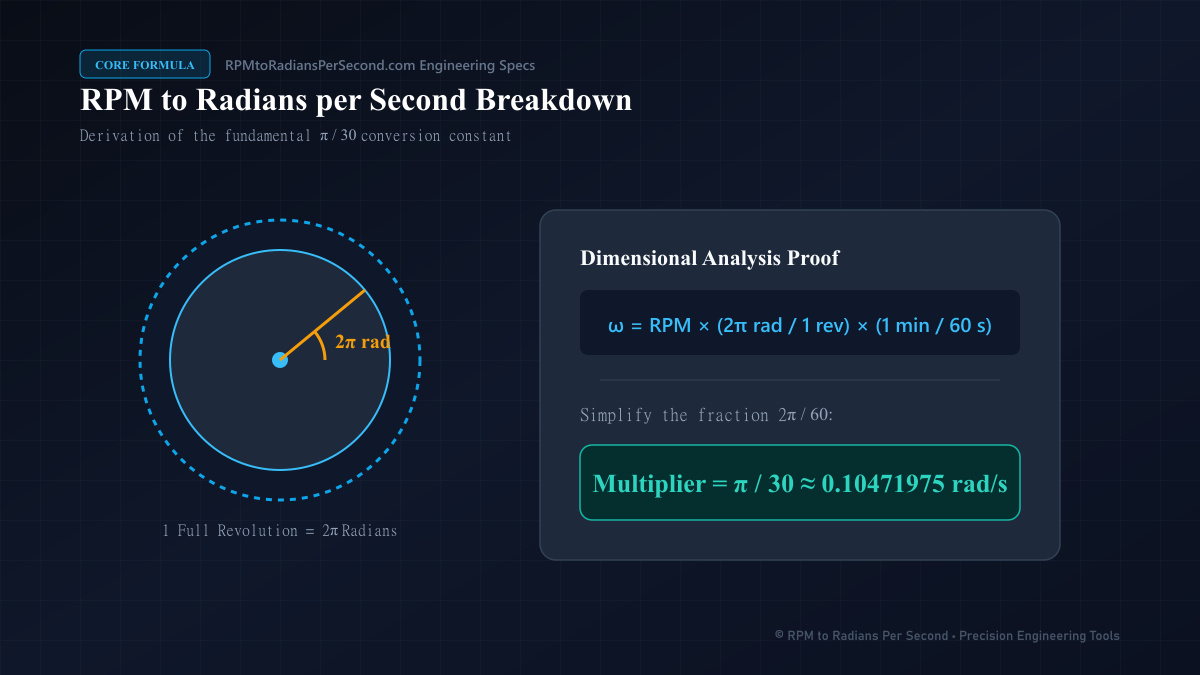
This direct relationship makes 60 RPM the primary teaching benchmark in university physics courses, such as those published by MIT OpenCourseWare. To explore how rotational speed links directly to wave cycles and electrical waveforms, consult our deep dive on rpm to hz.
| Application | Rotational Speed | Frequency (Hz) | Angular Velocity (rad/s) |
|---|---|---|---|
| Clock Second Hand | 1 RPM | 0.0167 Hz | π/30 rad/s ≈ 0.1047 rad/s |
| Direct 1 Hz Benchmark | 60 RPM | 1.0000 Hz | 2π rad/s ≈ 6.2832 rad/s |
| Two-Cycle Turntable Baseline | 120 RPM | 2.0000 Hz | 4π rad/s ≈ 12.5664 rad/s |
| Low-Speed Industrial Agitator | 30 RPM | 0.5000 Hz | π rad/s ≈ 3.1416 rad/s |
Step-by-Step Mathematical Derivation
To convert any speed from revolutions per minute to radians per second, multiply by the conversion factor π / 30. This dimensional factor is standard across SI unit systems documented by the NIST Guide to SI Units.
The derivation is simple:
- One revolution represents an angular displacement of
2πradians. - One minute represents an elapsed time of
60seconds. - Forming the conversion ratio:
(2π rad) / (60 s) = π / 30 rad/s per RPM.
Now multiply this ratio by 60 RPM:
ω = 60 × (π / 30) = (60 / 30) × π = 2π rad/sCarrying out the multiplication with decimal π:
2 × 3.1415926535... ≈ 6.283185 rad/sFor further algebraic derivations and reciprocal conversion factors, visit our foundation article on rpm to radians per second.
Peripheral Surface Speed at 60 RPM
Even at a modest 60 RPM, large rotating bodies develop substantial peripheral velocity. The linear surface velocity equation links radius to tangential speed:
v = r × ωWhere:
- v is tangential surface speed measured in meters per second (m/s).
- r represents component radius in meters (m).
- ω is rotational angular velocity expressed in radians per second (rad/s).
Because angular velocity is exactly 2π rad/s, linear velocity simplifies to v = 2πr. This means that in exactly one second, any point on the perimeter travels a distance equal to the circumference of the circle:
| Rotating Body | Diameter | Radius (r) | Linear Speed (m/s) | Surface Speed (ft/min) | Velocity (km/h) |
|---|---|---|---|---|---|
| Small Pulley | 100 mm (0.10 m) | 0.05 m | 0.314 m/s | 61.8 SFM | 1.13 km/h |
| Car Tire (24-inch) | 610 mm (0.61 m) | 0.305 m | 1.916 m/s | 377.2 SFM | 6.90 km/h |
| Water Treatment Drum | 2.0 meters | 1.00 m | 6.283 m/s | 1,236.9 SFM | 22.62 km/h |
| Theme Park Ferris Wheel | 20.0 meters | 10.00 m | 62.832 m/s | 12,368.5 SFM | 226.19 km/h |
Notice that on a 2-meter diameter drum, the rim moves at over 6.28 meters per second. For practical engineering formulas covering surface speeds and belt travel, explore our guide on rpm to linear velocity.
Gear Reduction: Achieving 60 RPM from Standard Motors
Because standard 4-pole AC induction motors spin at roughly 1,800 RPM, achieving 60 RPM requires mechanical speed reduction. Guidelines from the IEEE provide standard motor ratings for automated industrial machinery.
To calculate the required reduction ratio:
Gear Ratio = Motor Input RPM / Output RPM = 1,800 / 60 = 30:1A 30:1 gearbox steps down rotational velocity from 188.50 rad/s to 6.28 rad/s. In accordance with the conservation of energy, the gearbox amplifies the output torque by a factor of 30, less mechanical gear train efficiency losses. For multi-stage planetary and worm drive sizing, review our gear ratio rpm calculator.
If you are dealing with twice this speed in mixer applications, check our analysis of 120 rpm to radians per second.
Developer & Simulation Code
Physics simulations and robot kinematic models frequently transform rotational inputs into radians per second.
Python Function
import math

def convert_60_rpm() -> float:
    rpm = 60.0
    return rpm * (math.pi / 30.0)

angular_velocity = convert_60_rpm()
print(f"Angular Velocity: {angular_velocity:.6f} rad/s") # Output: 6.283185 rad/s
C / C++ Implementation
#include <iostream>
#include <cmath>

int main() {
    double rpm = 60.0;
    double omega = rpm * (M_PI / 30.0);
    std::cout << "Angular Velocity: " << omega << " rad/s\n";
    return 0;
}
To learn more about rotational vectors, right-hand rules, and angular kinematics, read our foundational angular velocity guide.
Frequently Asked Questions
What is 60 RPM in radians per second?
60 RPM equals exactly 2π rad/s, which is approximately 6.283185 radians per second.
Why does 60 RPM equal 1 Hz?
There are 60 seconds in one minute. Therefore, 60 revolutions per minute equals 1 revolution per second, which is defined as 1 Hertz.
How do you convert 60 RPM to rad/s manually?
Multiply 60 by π and divide by 30. Since 60 divided by 30 is 2, the exact answer is 2π rad/s (approx. 6.283 rad/s).
What is the linear velocity of a 1-meter radius wheel at 60 RPM?
Using v = r × ω, a 1-meter radius wheel has a linear surface velocity of 1 m × 2π rad/s = 2π m/s (approx. 6.283 meters per second, or 22.62 km/h).
What gear ratio is needed to turn an 1800 RPM motor into 60 RPM?
A 30:1 speed reducer is required (1800 / 60 = 30). This reduces speed thirty-fold while multiplying output torque by 30 before friction losses.
Ready to run the numbers?
Get your result instantly — private, in your browser.