RPM to Radians Per Second: The Ultimate Conversion Guide
Master the rpm to radians per second conversion. Get the exact formula, avoid rounding errors, understand the calculus, and use our free calculator.
Read articleConvert RPM to radians per second (rad/s) and back with the exact π/30 factor. Get rad/s, degrees per second, frequency in Hz, rotation period and surface speed (v = ω·r) instantly.
Last updated:
Complete dimensional derivation and multi-step conversion method
ω = RPM × (π / 30) rad/sChoose the rotational speed unit you want to convert from:
Choose your starting unit: Revolutions Per Minute (RPM), Radians Per Second (rad/s), Frequency in Hertz (Hz, rev/s), or Degrees Per Second (°/s). The converter dynamically adapts in real time.
Enter your numeric speed value or pick a machinery benchmark. If you are analyzing a rotating rotor, shaft, pulley, wheel, or centrifuge, specify the radius in meters to instantly calculate linear tangential surface speed (m/s, km/h, mph).
Review instant results across all rotational metrics: exact rad/s, RPM, cycle period per revolution, rotational frequency, and peripheral linear speed.
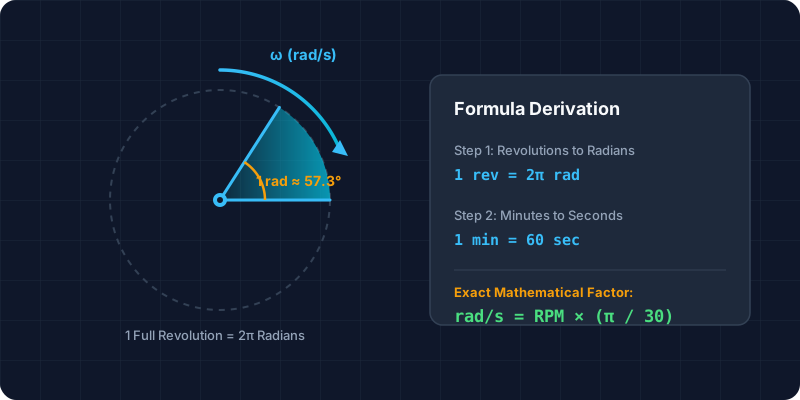
Quick Answer: To convert RPM (revolutions per minute) to rad/s (radians per second), multiply by π and divide by 30 (or multiply by approximately 0.1047197551): ω = RPM × (π / 30) rad/s To convert radians per second (rad/s) back to RPM, multiply by 30 and divide by π (or multiply by approximately 9.5492965855): RPM = ω × (30 / π) Mathematical Derivation From First Principles: 1. One complete revolution equals 360 degrees, which is exactly 2π radians (~6.2831853 rad). 2. One minute equals exactly 60 seconds. 3. Multiplying RPM by 2π radians per revolution and dividing by 60 seconds per minute gives: ω = RPM × (2π / 60) rad/s. 4. Simplifying 2π/60 by dividing numerator and denominator by 2 yields the exact analytical conversion factor: ω = RPM × (π / 30) rad/s. Notations, Common Synonyms & Unit Variations: Rotational velocity is expressed across literature in multiple equivalent notations: • Revolutions per minute: RPM, rev/min, rev per min, rev min, or r/min. • Radians per second: rad/s, rad/sec, rad sec, rads, or rad per second. All of these notations describe the same quantities, so the same π/30 factor applies to each. Practical Engineering Guidance: Avoid using rounded decimals like 0.10472 in multi-stage engineering code. In gear trains, electric motor torque estimations (P = τ·ω), and torsional vibration models, using truncated constants causes cumulative floating-point error. Retaining the symbolic fraction π/30 guarantees exact scientific precision.
RPM to rad/s:
  ω (rad/s) = RPM × 2π ÷ 60
            = RPM × π/30 ≈ RPM × 0.1047197551

rad/s to RPM:
  RPM       = ω × 60 ÷ 2π
            = ω × 30/π ≈ ω × 9.5492965855

Related Rotational Relationships:
  Frequency f (Hz)            = RPM ÷ 60 = ω ÷ 2π
  Degrees per Second (°/s)    = rad/s × 180/π = RPM × 6
  Period T (s/rev)            = 60 ÷ RPM = 2π ÷ ω
Tangential Velocity v (m/s) = ω × r = (RPM × π ÷ 30) × rWorked Step-by-Step Examples: Example 1: Convert 1,800 RPM (standard 4-pole synchronous motor) to rad/s: ω = 1,800 × π / 30 = 60π ≈ 188.49556 rad/s. Frequency: f = 1,800 / 60 = 30 Hz. Period: T = 60 / 1,800 ≈ 0.0333 seconds per rev. Example 2: Convert 100 rad/s to RPM: RPM = 100 × 30 / π = 3,000 / π ≈ 954.93 RPM. Example 3: Tangential linear speed of a 0.25 m radius flywheel at 3,000 RPM: ω = 3,000 × π / 30 = 100π ≈ 314.159 rad/s. v = ω × r = 314.159 rad/s × 0.25 m = 78.54 m/s (282.74 km/h or 175.69 mph).
| Engineering Scenario | Calculation | Kinematic Result |
|---|---|---|
| Automotive Engine — 3,000 RPM → rad/s | 3,000 × π/30 | 314.159265 rad/s · 50 Hz · 18,000 °/s · 0.02 s/rev |
| AC Induction Motor — 1,800 RPM → rad/s | 1,800 × π/30 = 60π | 188.495559 rad/s · 30 Hz · 10,800 °/s · 0.0333 s/rev |
| Industrial Motor — 1,500 RPM → rad/s | 1,500 × π/30 = 50π | 157.079633 rad/s · 25 Hz · 9,000 °/s · 0.04 s/rev |
| Enterprise Hard Drive — 7,200 RPM → rad/s + Hz | 7,200 × π/30 = 240π | 753.982237 rad/s · 120 Hz · 43,200 °/s · 0.00833 s/rev |
| Angle Grinder — 11,000 RPM → rad/s | 11,000 × π/30 | 1,151.917306 rad/s · 183.33 Hz · 66,000 °/s |
| Reverse Conversion — 100 rad/s → RPM | 100 × 30/π | 954.929659 RPM · 15.915 Hz · 5,729.578 °/s |
| RPM | rad/s | Hz | °/s | Period (s) |
|---|---|---|---|---|
| 1 | 0.10472 | 0.0167 | 6 | 60 |
| 2 | 0.20944 | 0.0333 | 12 | 30 |
| 3 | 0.31416 | 0.05 | 18 | 20 |
| 4 | 0.41888 | 0.0667 | 24 | 15 |
| 5 | 0.52360 | 0.0833 | 30 | 12 |
| 6 | 0.62832 | 0.1 | 36 | 10 |
| 7 | 0.73304 | 0.1167 | 42 | 8.5714 |
| 8 | 0.83776 | 0.1333 | 48 | 7.5 |
| 9 | 0.94248 | 0.15 | 54 | 6.6667 |
| 10 | 1.04720 | 0.1667 | 60 | 6 |
| 11 | 1.15192 | 0.1833 | 66 | 5.4545 |
| 12 | 1.25664 | 0.2 | 72 | 5 |
| 13 | 1.36136 | 0.2167 | 78 | 4.6154 |
| 14 | 1.46608 | 0.2333 | 84 | 4.2857 |
| 15 | 1.57080 | 0.25 | 90 | 4 |
| 16 | 1.67552 | 0.2667 | 96 | 3.75 |
| 17 | 1.78024 | 0.2833 | 102 | 3.5294 |
| 18 | 1.88496 | 0.3 | 108 | 3.3333 |
| 19 | 1.98968 | 0.3167 | 114 | 3.1579 |
| 20 | 2.09440 | 0.3333 | 120 | 3 |
| 21 | 2.19911 | 0.35 | 126 | 2.8571 |
| 22 | 2.30383 | 0.3667 | 132 | 2.7273 |
| 23 | 2.40855 | 0.3833 | 138 | 2.6087 |
| 24 | 2.51327 | 0.4 | 144 | 2.5 |
| 25 | 2.61799 | 0.4167 | 150 | 2.4 |
| 26 | 2.72271 | 0.4333 | 156 | 2.3077 |
| 27 | 2.82743 | 0.45 | 162 | 2.2222 |
| 28 | 2.93215 | 0.4667 | 168 | 2.1429 |
| 29 | 3.03687 | 0.4833 | 174 | 2.069 |
| 30 | 3.14159 | 0.5 | 180 | 2 |
| 31 | 3.24631 | 0.5167 | 186 | 1.9355 |
| 32 | 3.35103 | 0.5333 | 192 | 1.875 |
| 33 | 3.45575 | 0.55 | 198 | 1.8182 |
| 34 | 3.56047 | 0.5667 | 204 | 1.7647 |
| 35 | 3.66519 | 0.5833 | 210 | 1.7143 |
| 36 | 3.76991 | 0.6 | 216 | 1.6667 |
| 37 | 3.87463 | 0.6167 | 222 | 1.6216 |
| 38 | 3.97935 | 0.6333 | 228 | 1.5789 |
| 39 | 4.08407 | 0.65 | 234 | 1.5385 |
| 40 | 4.18879 | 0.6667 | 240 | 1.5 |
| 41 | 4.29351 | 0.6833 | 246 | 1.4634 |
| 42 | 4.39823 | 0.7 | 252 | 1.4286 |
| 43 | 4.50295 | 0.7167 | 258 | 1.3953 |
| 44 | 4.60767 | 0.7333 | 264 | 1.3636 |
| 45 | 4.71239 | 0.75 | 270 | 1.3333 |
| 46 | 4.81711 | 0.7667 | 276 | 1.3043 |
| 47 | 4.92183 | 0.7833 | 282 | 1.2766 |
| 48 | 5.02655 | 0.8 | 288 | 1.25 |
| 49 | 5.13127 | 0.8167 | 294 | 1.2245 |
| 50 | 5.23599 | 0.8333 | 300 | 1.2 |
| 51 | 5.34071 | 0.85 | 306 | 1.1765 |
| 52 | 5.44543 | 0.8667 | 312 | 1.1538 |
| 53 | 5.55015 | 0.8833 | 318 | 1.1321 |
| 54 | 5.65487 | 0.9 | 324 | 1.1111 |
| 55 | 5.75959 | 0.9167 | 330 | 1.0909 |
| 56 | 5.86431 | 0.9333 | 336 | 1.0714 |
| 57 | 5.96903 | 0.95 | 342 | 1.0526 |
| 58 | 6.07375 | 0.9667 | 348 | 1.0345 |
| 59 | 6.17847 | 0.9833 | 354 | 1.0169 |
| 60 | 6.28319 | 1 | 360 | 1 |
| 61 | 6.38791 | 1.0167 | 366 | 0.9836 |
| 62 | 6.49262 | 1.0333 | 372 | 0.9677 |
| 63 | 6.59734 | 1.05 | 378 | 0.9524 |
| 64 | 6.70206 | 1.0667 | 384 | 0.9375 |
| 65 | 6.80678 | 1.0833 | 390 | 0.9231 |
| 66 | 6.91150 | 1.1 | 396 | 0.9091 |
| 67 | 7.01622 | 1.1167 | 402 | 0.8955 |
| 68 | 7.12094 | 1.1333 | 408 | 0.8824 |
| 69 | 7.22566 | 1.15 | 414 | 0.8696 |
| 70 | 7.33038 | 1.1667 | 420 | 0.8571 |
| 71 | 7.43510 | 1.1833 | 426 | 0.8451 |
| 72 | 7.53982 | 1.2 | 432 | 0.8333 |
| 73 | 7.64454 | 1.2167 | 438 | 0.8219 |
| 74 | 7.74926 | 1.2333 | 444 | 0.8108 |
| 75 | 7.85398 | 1.25 | 450 | 0.8 |
| 76 | 7.95870 | 1.2667 | 456 | 0.7895 |
| 77 | 8.06342 | 1.2833 | 462 | 0.7792 |
| 78 | 8.16814 | 1.3 | 468 | 0.7692 |
| 79 | 8.27286 | 1.3167 | 474 | 0.7595 |
| 80 | 8.37758 | 1.3333 | 480 | 0.75 |
| 81 | 8.48230 | 1.35 | 486 | 0.7407 |
| 82 | 8.58702 | 1.3667 | 492 | 0.7317 |
| 83 | 8.69174 | 1.3833 | 498 | 0.7229 |
| 84 | 8.79646 | 1.4 | 504 | 0.7143 |
| 85 | 8.90118 | 1.4167 | 510 | 0.7059 |
| 86 | 9.00590 | 1.4333 | 516 | 0.6977 |
| 87 | 9.11062 | 1.45 | 522 | 0.6897 |
| 88 | 9.21534 | 1.4667 | 528 | 0.6818 |
| 89 | 9.32006 | 1.4833 | 534 | 0.6742 |
| 90 | 9.42478 | 1.5 | 540 | 0.6667 |
| 91 | 9.52950 | 1.5167 | 546 | 0.6593 |
| 92 | 9.63422 | 1.5333 | 552 | 0.6522 |
| 93 | 9.73894 | 1.55 | 558 | 0.6452 |
| 94 | 9.84366 | 1.5667 | 564 | 0.6383 |
| 95 | 9.94838 | 1.5833 | 570 | 0.6316 |
| 96 | 10.05310 | 1.6 | 576 | 0.625 |
| 97 | 10.15782 | 1.6167 | 582 | 0.6186 |
| 98 | 10.26254 | 1.6333 | 588 | 0.6122 |
| 99 | 10.36726 | 1.65 | 594 | 0.6061 |
| 100 | 10.47198 | 1.6667 | 600 | 0.6 |
| 120 | 12.56637 | 2 | 720 | 0.5 |
| 180 | 18.84956 | 3 | 1,080 | 0.3333 |
| 200 | 20.94395 | 3.3333 | 1,200 | 0.3 |
| 300 | 31.41593 | 5 | 1,800 | 0.2 |
| 500 | 52.35988 | 8.3333 | 3,000 | 0.12 |
| 600 | 62.83185 | 10 | 3,600 | 0.1 |
| 750 | 78.53982 | 12.5 | 4,500 | 0.08 |
| 900 | 94.24778 | 15 | 5,400 | 0.0667 |
| 1,000 | 104.71976 | 16.6667 | 6,000 | 0.06 |
| 1,200 | 125.66371 | 20 | 7,200 | 0.05 |
| 1,450 | 151.84364 | 24.1667 | 8,700 | 0.0414 |
| 1,500 | 157.07963 | 25 | 9,000 | 0.04 |
| 1,750 | 183.25957 | 29.1667 | 10,500 | 0.0343 |
| 1,800 | 188.49556 | 30 | 10,800 | 0.0333 |
| 2,400 | 251.32741 | 40 | 14,400 | 0.025 |
| 2,850 | 298.45130 | 47.5 | 17,100 | 0.0211 |
| 3,000 | 314.15927 | 50 | 18,000 | 0.02 |
| 3,450 | 361.28316 | 57.5 | 20,700 | 0.0174 |
| 3,600 | 376.99112 | 60 | 21,600 | 0.0167 |
| 5,000 | 523.59878 | 83.3333 | 30,000 | 0.012 |
| 5,400 | 565.48668 | 90 | 32,400 | 0.0111 |
| 7,200 | 753.98224 | 120 | 43,200 | 0.0083 |
| 10,000 | 1047.19755 | 166.6667 | 60,000 | 0.006 |
| 15,000 | 1570.79633 | 250 | 90,000 | 0.004 |
| 20,000 | 2094.39510 | 333.3333 | 120,000 | 0.003 |
Engineering & Applied Kinematics Specialists
Our engineering and editorial specialists build, review, and mathematically verify rotational kinematics tools and technical datasets against international SI metrology standards.
Master the rpm to radians per second conversion. Get the exact formula, avoid rounding errors, understand the calculus, and use our free calculator.
Read articleA practical guide to angular velocity. Learn what it is, how it differs from linear velocity, and why it is universally measured in radians per second.
Read articleStandard AC motor RPMs for 50Hz and 60Hz grids. Learn synchronous speed formulas, induction slip, and exact rad/s conversions for motor sizing.
Read articleTo convert RPM (revolutions per minute) to rad/s (radians per second), multiply the RPM by π and divide by 30 (or multiply by approximately 0.1047197551). Formula: rad/s = RPM × (π / 30). For example, to convert 1,800 RPM: 1,800 × π / 30 = 60π ≈ 188.49556 rad/s.
To convert radians per second (rad/s) to RPM, multiply the rad/s value by 30 and divide by π (or multiply by approximately 9.5492965855). Formula: RPM = rad/s × (30 / π). For example, 100 rad/s converts to 100 × 30 / π ≈ 954.93 RPM.
1 RPM equals exactly π/30 radians per second, which is approximately 0.10472 rad/s (or 6 degrees per second).
1 rad/s equals exactly 30/π revolutions per minute, which is approximately 9.5493 RPM.
Angular velocity (symbol ω) is the rate of rotational displacement per unit of time, measuring how fast an object turns through an angle. In coherent SI units, it is measured in radians per second (rad/s). One radian equals approximately 57.2958 degrees (180°/π). An object turning at 1 rad/s sweeps through one radian of angle every single second.
The exact formula is: ω = RPM × (2π / 60) = RPM × (π / 30) rad/s. Here, ω represents angular velocity in radians per second, and RPM represents rotational speed in revolutions per minute.
The formula to convert rad/s to RPM is: RPM = ω × (60 / 2π) = ω × (30 / π). The factor 30/π evaluates to approximately 9.5492965855.
The conversion factor π/30 comes from two unit definitions: there are 2π radians in one full revolution (360°), and 60 seconds in one minute. Multiplying by 2π rad/rev and dividing by 60 s/min gives 2π/60, which simplifies by dividing numerator and denominator by 2 to π/30.
1,800 RPM equals exactly 60π radians per second, which is approximately 188.49556 rad/s (rotational frequency of 30 Hz). This is the synchronous speed for a standard 4-pole AC motor on a 60 Hz grid.
3,600 RPM equals exactly 120π radians per second, which is approximately 376.99112 rad/s (rotational frequency of 60 Hz). This is the synchronous speed for a 2-pole AC electric motor on a 60 Hz electrical grid.
120 RPM equals exactly 4π radians per second, which is approximately 12.56637 rad/s (frequency of 2 Hz, period of 0.5 s/rev).
RPM measures the number of complete 360° rotational turns an object completes each minute. Rad/s (radians per second) is the SI base derived unit measuring the rate of angular displacement per second. Physics and engineering equations (torque P = τ·ω, rotational kinetic energy E = ½I·ω², and centripetal acceleration a = ω²r) strictly require angular velocity in rad/s.
To convert RPM to Hertz (Hz, revolutions per second), divide RPM by 60: f = RPM / 60. For example, 3,000 RPM equals 3,000 / 60 = 50 Hz, which matches the standard European electrical grid frequency.
To calculate linear tangential velocity (v), you need both rotational speed (RPM) and the radius (r) from the center of rotation: First, convert RPM to angular velocity: ω = RPM × π / 30. Second, multiply by radius: v = ω × r. For example, a 0.3 m radius wheel rotating at 600 RPM has ω = 62.83 rad/s, producing a surface speed of v = 62.83 × 0.3 = 18.85 m/s (67.86 km/h or 42.17 mph).
The rotational period (T) is the time required for one complete 360° turn: T = 60 / RPM seconds. For example, at 1,200 RPM, one revolution takes 60 / 1,200 = 0.05 seconds (50 milliseconds).
Rev/min is identical to RPM, and rad/sec is an alternative scientific notation for rad/s. Multiply your rev/min value by π and divide by 30 to get rad/sec: rad/sec = rev/min × (π / 30).