RPM to Radians Per Second: The Ultimate Conversion Guide
Master the rpm to radians per second conversion. Get the exact formula, avoid rounding errors, understand the calculus, and use our free calculator.
You are staring at a motor spec sheet that says 3,000 RPM, but your kinematics equation demands radians per second. If you plug RPM directly into that formula, the entire calculation fails and your grade tanks. We have all been there. The tension between the mechanical world (which loves RPM) and the theoretical physics world (which demands rad/s) is one of the most frustrating hurdles in early engineering.
The math to fix this is actually entirely straightforward, even if your brain feels fried. You just multiply your RPM by the exact fraction π/30.
If you are just trying to survive an assignment or size a motor quickly, drop your number into the calculator below to get the precise answer immediately.
If you want to understand exactly why this works, how it affects your calculus, and how to write code to automate it, keep reading. We are going to break down the rpm to radians per second pipeline completely.
The Math Behind RPM to Radians Per Second
When you convert rpm to radians per second, you are translating a "real-world" mechanical measurement into the strict mathematical language of angular velocity. According to the International System of Units (SI) and the NIST Guide to SI Units, the radian is the coherent SI unit of plane angle, and rad/s is the coherent unit of angular velocity.
The math requires changing two entirely different units at the same time:
- Distance (Revolutions to Radians): One full circle is defined mathematically as exactly 2π radians. So, to find out how much "distance" is covered in a circle, you multiply your RPM by 2π.
- Time (Minutes to Seconds): There are 60 seconds in a minute. To find the rate per second instead of per minute, you must divide your result by 60.
When you combine those two necessary steps (2π / 60), the fraction reduces perfectly to the base multiplier: π/30. If you want the full dimensional-analysis proof, including why the radian is dimensionless, read our dedicated RPM to rad/s formula derivation.
rad/s = RPM × (π / 30)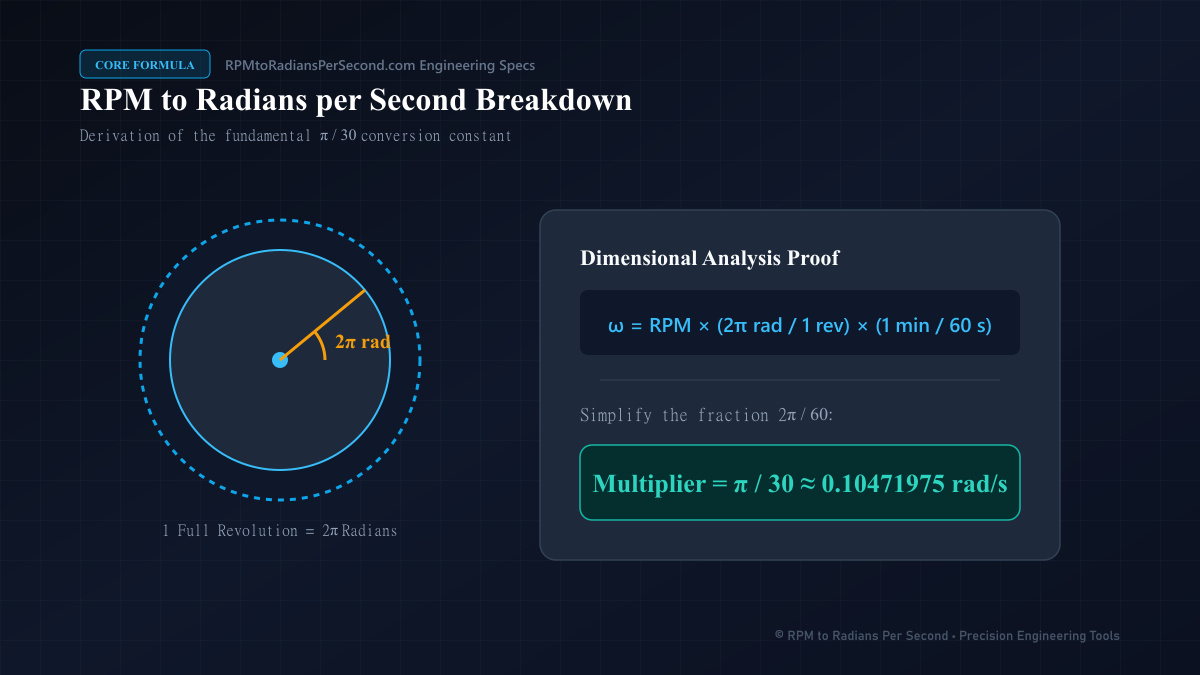
Step-by-Step Conversion Flow
Let's look at the numbers in a real-world scenario. Say you need to convert a standard electric motor spinning at 1,500 RPM for a physics midterm.
- Take your starting value: 1,500 RPM
- Apply the multiplier:
1,500 × (π/30) - Simplify the fraction:
1,500 / 30 = 50 - Final exact result:
50π rad/s
If you absolutely must punch it into a decimal-based software that cannot parse Pi, 50 multiplied by π is approximately 157.0796 rad/s. Always use at least four decimal places if you are forced to round. Want the same flow broken into exam-ready habits and common mistakes? Our step-by-step conversion walkthrough covers it.
Popular Speeds: Quick Reference Table
These are the rpm to radians per second values engineers look up most often. For a complete directory of all values, explore our conversion index.
| Speed (RPM) | Exact (rad/s) | Decimal (rad/s) |
|---|---|---|
| 60 RPM | 2π | 6.283 |
| 120 RPM | 4π | 12.566 |
| 1,000 RPM | 100π/3 | 104.720 |
| 1,500 RPM | 50π | 157.080 |
| 1,800 RPM | 60π | 188.496 |
| 3,000 RPM | 100π | 314.159 |
| 3,600 RPM | 120π | 376.991 |
| 5,800 RPM | 580π/3 | 607.375 |
| 6,000 RPM | 200π | 628.319 |
The Standard Speeds Cheat Sheet
Whether you are looking at 120 RPM for a low-speed AC drive or testing 1 RPM for a slow gear reduction, keeping a reference table of real machines handy saves time on exams.
| Machine / Application | Speed (RPM) | Exact Multiplier | Exact Angular Velocity (rad/s) | Approx Decimal (rad/s) |
|---|---|---|---|---|
| Ceiling Fan (Low) | 60 | 60 × (π/30) | 2π | 6.283 |
| Bicycle Cadence (Sprint) | 120 | 120 × (π/30) | 4π | 12.566 |
| Car Engine Idle | 800 | 800 × (π/30) | 80π/3 | 83.776 |
| Washing Machine Spin Cycle | 1,200 | 1,200 × (π/30) | 40π | 125.664 |
| 4-Pole Induction Motor (60 Hz) | 1,800 | 1,800 × (π/30) | 60π | 188.496 |
| Angle Grinder | 10,000 | 10,000 × (π/30) | 1,000π/3 | 1,047.198 |
| Dental Drill (Turbine) | 300,000 | 300,000 × (π/30) | 10,000π | 31,415.927 |
Notice how multiples of 30 produce clean Pi integers. If your motor spins at 120 RPM, the math reduces cleanly to 4π rad/s.
Why Does Calculus Demand rad/s?
RPM is fantastic for humans. It is easy to picture a shaft spinning three thousand times a minute, count the rotations on a tachometer, and divide by the minute. So why do physicists hate it? Because radians are the natural language of geometry and calculus.
A radian isn't just an arbitrary slice of a circle like a degree is (the 360-degree circle is usually traced back to Babylonian base-60 astronomy). A radian relates directly to the physical radius of the circle. When the arc length along the edge of a circle equals the radius of that circle, the angle created is exactly one radian.
Because both arc length and radius are measured in meters, the radian is a pure ratio (meters / meters = 1). That purity means that when you take the derivative of trigonometric functions (which you must do to find acceleration from velocity) the math stays clean:
- The derivative of
sin(θ)where θ is in radians is simplycos(θ). - If you tried to take the derivative of
sin(θ)where θ is in degrees, the result is(π/180) × cos(θ).
Imagine having to carry that π/180 garbage through a massive calculus equation. It would be a disaster. The same logic applies to RPM: every formula would need an extra π/30 correction factor.
The Linear Velocity Formula (v = rω)
Because a radian is tied directly to the radius, using rad/s allows equations connecting rotational speed to linear speed to be incredibly clean. The classic kinematics formula for linear (tangential) velocity (v) is simply the radius (r) multiplied by the angular velocity (ω):
v = r × ω
If you tried to plug RPM directly into that formula, your answer would be off by a factor of roughly 9.55. You must execute the rpm to radians per second conversion first. For example, a wheel with a 0.5 m radius spinning at 100 rad/s (about 955 RPM) has a rim speed of 0.5 × 100 = 50 m/s. Enter 955 RPM below and add a radius of 0.5 m to see the linear velocity in m/s, km/h, and mph:
For wheel, belt, and conveyor examples in every unit, see our full rpm to linear velocity guide.
Calculating Centripetal Acceleration
Once you have your angular velocity in rad/s, you can also easily calculate the centripetal acceleration (the inward acceleration that the rotor material must supply to keep every particle on its circular path). The formula is:
a = r × ω²
If you are designing a flywheel, you need this formula to ensure the metal won't literally tear itself apart at high speeds. Again, this formula absolutely requires ω to be in radians per second.
| Flywheel Radius (m) | Speed (RPM) | Angular Velocity (rad/s) | Centripetal Acceleration (m/s²) |
|---|---|---|---|
| 0.25 | 3000 | 100π (~314.16) | ~24,674 |
| 0.50 | 3000 | 100π (~314.16) | ~49,348 |
| 0.25 | 6000 | 200π (~628.32) | ~98,696 |
Notice how doubling the radius doubles the acceleration, but doubling the RPM (and thus rad/s) quadruples it because ω is squared!
The same ω² behavior drives stored energy: rotational kinetic energy is E = ½ × I × ω², so doubling a flywheel's speed stores four times the energy. Our rotational kinetic energy calculator guide works through inertia formulas and braking power step by step.
Coding the Conversion Pipeline
When building robotics controls, simulation scripts, or web tools, always calculate angular velocity dynamically. Here is the safest, most precise way to code it without falling into the rounding trap.
Python Implementation
import math

def rpm_to_rads(rpm: float) -> dict:
    """Converts RPM into exact and decimal angular velocity."""
    rad_s = rpm * (math.pi / 30.0)
    return {
        "rpm": rpm,
        "rad_per_sec": round(rad_s, 5),
        "exact_pi_multiple": f"({rpm}/30) * π"
    }

# Example: 1800 RPM industrial motor
print(rpm_to_rads(1800))
# Output: {'rpm': 1800, 'rad_per_sec': 188.49556, 'exact_pi_multiple': '(1800/30) * π'}
JavaScript Implementation
function convertRpmToRads(rpm) {
  if (typeof rpm !== "number" || isNaN(rpm)) {
    throw new TypeError("RPM must be a valid number");
  }
  return rpm * (Math.PI / 30);
}

// Example: 3600 RPM
console.log(convertRpmToRads(3600)); // 376.99111843077515
By relying on the built-in Pi constants in these languages, you push the rounding error down to the 15th or 16th significant digit, which is generally safe for anything short of orbital mechanics.
Real-World Engineering Scenarios
Why do we spend so much time on this single conversion? Because it is the bridge between the mechanical catalog and the physics simulator.
Scenario 1: Robotics and Joint Speed
When you buy a servo motor for a robotic arm, the box says "60 RPM." But when you program the kinematics solver to move the arm from Point A to Point B, the matrix math requires the joint speeds in rad/s. You must convert that 60 RPM to 2π rad/s so your software knows exactly how fast the arm is sweeping through its arc.
Scenario 2: Automotive Drivetrains
A car's dashboard shows the engine speed in RPM. However, to calculate the actual speed of the car rolling down the highway, an automotive engineer must convert that engine RPM (modified by the gear ratios) into the angular velocity of the tire in rad/s. They then multiply that rad/s by the radius of the tire to find the linear velocity (mph or km/h).
Scenario 3: Hard Drive Latency
A standard hard drive spins at 7,200 RPM. To calculate the rotational latency (the fraction of a second it takes for the data sector to spin under the read/write head) computer engineers convert that RPM to rad/s (roughly 754 rad/s) to accurately model the physics of the spinning platters.
Frequently Asked Questions
1. What is the precise multiplier to convert RPM to rad/s?
The precise mathematical multiplier is π/30. You simply multiply your Revolutions Per Minute by this exact fraction to get radians per second.
2. Can I just multiply RPM by 0.10472?
You can for rough estimates, but it is highly discouraged for precision engineering. 0.10472 is a rounded approximation of π/30. Using it introduces compounding rounding errors into multi-step physics problems.
3. How do I go backward from rad/s to RPM?
To reverse the math, you multiply your rad/s value by the reciprocal fraction: 30/π. We have a full guide covering how to convert radians per second to rpm.
4. What is the difference between rad/s and Hertz (Hz)?
Hertz (Hz) measures full revolutions per second, while rad/s measures radians per second. Because there are 2π radians in a single revolution, 1 Hz is exactly equal to 2π rad/s. To find Hz from RPM, simply divide by 60, or review our rpm to hz guide.
5. Why do motor datasheets use RPM instead of rad/s?
RPM is an intuitive, human-readable format for technicians and mechanics working on physical hardware. However, physics and calculus equations require rad/s, which is why this conversion is universally necessary.
6. Is angular velocity a vector?
Yes, angular velocity is technically a vector quantity. It has a magnitude (the rad/s speed we calculate here) and a direction. The direction is determined by the "right-hand rule" along the axis of rotation.
7. Does the radius of the object change the rad/s?
No. Angular velocity is independent of the radius. If a record is spinning at 33 RPM, a point near the center and a point on the outer edge both have the exact same angular velocity in rad/s. (However, the outer point will have a higher linear velocity).
8. What is 1 RPM in rad/s?
Exactly 1 RPM is equal to π/30 rad/s, which is approximately 0.1047 rad/s.
9. How do you find degrees per second from RPM?
First, convert your RPM to rad/s. Then, multiply the rad/s value by 180/π. Alternatively, since 1 RPM is 1 revolution (360 degrees) per 60 seconds, 1 RPM is exactly 6 degrees per second.
10. Can I use this formula for planetary orbits?
Yes. The math of angular velocity is universal. Whether it is a gear in a watch or the Earth orbiting the Sun, the conversion from revolutions-per-time-period to radians-per-second remains mathematically identical.
Don't risk a rounding error on your next project. Bookmark our RPM to Radians Per Second Calculator to instantly generate exact π-based answers, decimal approximations, and linear velocities anytime you need them.
Ready to run the numbers?
Get your result instantly — private, in your browser.