3000 RPM to Rad/s: Exact Math & 2-Pole Motor Guide
Convert 3000 RPM to radians per second (100π rad/s). Learn why 2-pole AC induction motors and high-speed pumps on 50 Hz European grids run at this speed.
When inspecting a high-speed European motor or analyzing pump dynamics on an international engineering project, converting 3,000 RPM into radians per second is vital. Scrambling to recalculate angular velocity formulas while commissioning 50 Hz machinery creates unnecessary risk. The exact conversion for 3000 RPM to rad/s is 100π rad/s, which equals approximately 314.15927 rad/s. Here is the complete engineering breakdown.
The exact conversion for 3000 rpm to rad/s evaluates cleanly to 100π rad/s.
In decimal notation required by engineering simulation packages and dynamic balancing software, this calculates to 314.159265 rad/s. You can compute custom values on the fly with the interactive converter below, or browse our comprehensive table of standard machinery speeds in the conversions directory:
Why 3000 RPM Is the High-Speed 50 Hz Baseline
In territories utilizing a 50 Hz electrical power grid, 3,000 RPM represents the maximum rotational speed for an AC induction or synchronous motor operating directly from mains voltage without a variable frequency drive. It serves as the standard operating point for high-velocity machinery like multi-stage centrifugal pumps, industrial turbo compressors, and 2-pole steam turbine generators.
Guidelines established by the International Electrotechnical Commission (IEC) define synchronous baseline speed by the ratio of grid line frequency to magnetic stator poles.
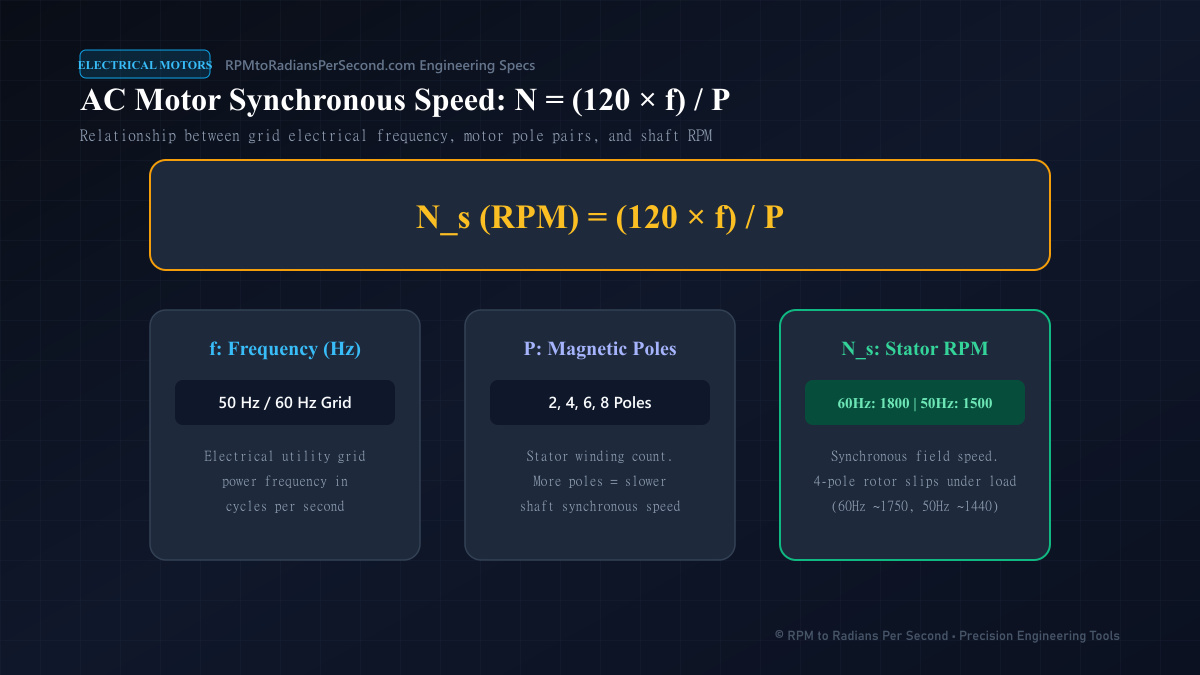
The synchronous speed formula calculates theoretical velocity without mechanical load:
N_s = (120 × f) / p = (120 × 50) / 2 = 3000 RPMWhere:
- f is the electrical line frequency (50 Hz).
- p is the number of electromagnetic stator poles (2 poles).
- 120 is the standard dimensional constant.
Because a 2-pole motor contains exactly one pair of north-south electromagnetic poles, the magnetic field completes a full 360-degree mechanical rotation during each electrical cycle. For a comprehensive comparison of synchronous speeds across grid frequencies, consult our guide on standard motor RPMs.
| Machine Classification | Operating Condition | Shaft Speed (RPM) | Angular Velocity (rad/s) |
|---|---|---|---|
| 50 Hz 2-Pole Synchronous Generator | Utility grid connection | 3,000 RPM | 100π rad/s ≈ 314.16 rad/s |
| IEC Standard 2-Pole Induction Motor | Full-load nameplate (approx. 2.7% slip) | 2,920 RPM | 97.33π rad/s ≈ 305.78 rad/s |
| 60 Hz 2-Pole Synchronous Generator | North American grid tie | 3,600 RPM | 120π rad/s ≈ 376.99 rad/s |
| High-Pressure Boiler Feed Pump | Direct coupled (50 Hz) | 2,950 RPM | 98.33π rad/s ≈ 308.92 rad/s |
Step-by-Step Mathematical Derivation
To convert rotational speed from revolutions per minute to radians per second, multiply by the conversion factor π / 30. This dimensional factor is standard across SI unit systems codified by the International Bureau of Weights and Measures (BIPM) and the NIST Guide to SI Units.
The derivation is straightforward:
- One full revolution encompasses an angular displacement of
2πradians. - One minute encompasses an elapsed time of
60seconds. - Forming the unit cancellation ratio:
(2π rad) / (60 s) = π / 30 rad/s per RPM.
Multiplying this factor by 3,000 RPM yields:
ω = 3,000 × (π / 30) = (3,000 / 30) × π = 100π rad/sCarrying out the multiplication with high-precision decimal π:
100 × 3.1415926535... ≈ 314.159265 rad/sFor complete algebraic proofs and reciprocal conversion mechanics, consult our comprehensive resource on rpm to radians per second.
Peripheral Surface Speed at 3000 RPM
Because 3,000 RPM produces an angular velocity of 314.16 rad/s, peripheral surface speeds mount rapidly even on modest rotor diameters. Engineers apply the tangential velocity relation:
v = r × ωWhere:
- v represents linear surface speed in meters per second (m/s).
- r represents component radius in meters (m).
- ω represents rotational velocity in radians per second (rad/s).
Here is how linear surface speeds scale across typical rotor and impeller diameters spinning at 3,000 RPM:
| Metric Rotating Component | Outer Diameter | Radius (r) | Linear Speed (m/s) | Surface Speed (ft/min) | Velocity (km/h) |
|---|---|---|---|---|---|
| Small Shaft Journal | 50 mm (0.05 m) | 0.025 m | 7.85 m/s | 1,546 SFM | 28.27 km/h |
| Centrifugal Pump Impeller | 150 mm (0.15 m) | 0.075 m | 23.56 m/s | 4,638 SFM | 84.82 km/h |
| High-Speed Grinding Wheel | 200 mm (0.20 m) | 0.100 m | 31.42 m/s | 6,184 SFM | 113.10 km/h |
| Turbine Disk | 300 mm (0.30 m) | 0.150 m | 47.12 m/s | 9,276 SFM | 169.65 km/h |
Notice that on a 200 mm grinding wheel spinning at 3,000 RPM, the abrasive perimeter travels at over 113 kilometers per hour. For detailed engineering derivations connecting rim radius directly to travel distance, refer to our guide on rpm to linear velocity.
Frequency and Period at 3000 RPM
To determine rotational frequency in Hertz, divide the rotational speed by 60 seconds:
f = 3,000 RPM / 60 s = 50 HzA 3,000 RPM shaft completes exactly 50 mechanical revolutions every second. The rotational period required for one single 360-degree rotation is:
T = 1 / f = 1 / 50 s = 0.02 seconds (20 ms)In a 2-pole AC synchronous generator, this 50 Hz mechanical rotation produces a 50 Hz electrical waveform directly matching the European electrical grid. To learn more about electrical cycles versus mechanical shaft speed, read our analysis on rpm to hz.
To examine the 60 Hz equivalent speed for 2-pole motors, explore our detailed guide on 3600 rpm to rad/s.
Code Implementations for Automation Engineers
Simulation algorithms and digital twin software frequently calculate rotational kinematics for international machinery. Engineering curriculum materials, such as those published by MIT OpenCourseWare, emphasize maintaining high mathematical precision.
Python Code
import math

def convert_3000_rpm_to_rad_s() -> float:
    rpm = 3000.0
    return rpm * (math.pi / 30.0)

omega = convert_3000_rpm_to_rad_s()
print(f"Angular Velocity: {omega:.6f} rad/s") # Output: 314.159265 rad/s
To explore broader vector kinematics, rotation matrices, and right-hand rules, read our foundational angular velocity guide.
Frequently Asked Questions
What is 3000 RPM in radians per second?
3000 RPM equals exactly 100π rad/s, which evaluates to approximately 314.159265 radians per second.
Why do 2-pole AC motors spin at 3000 RPM in Europe?
On a 50 Hz electrical grid, synchronous speed is (120 × 50) / 2 = 3000 RPM. Because the stator has two magnetic poles, the magnetic field completes a full mechanical revolution with every electrical cycle.
What is the linear speed of a 150 mm impeller at 3000 RPM?
A 150 mm diameter impeller has a 0.075 meter radius. Multiplying this radius by 314.159 rad/s yields a peripheral rim speed of 23.56 meters per second (approx. 84.82 km/h).
How does 3000 RPM compare to 3600 RPM?
3,000 RPM is the 2-pole synchronous speed on a 50 Hz power grid, producing 314.16 rad/s. 3,600 RPM is the 2-pole synchronous speed on a 60 Hz grid, producing 376.99 rad/s.
What is the rotational period of a shaft spinning at 3000 RPM?
At 3,000 RPM, the shaft completes 50 rotations per second (50 Hz). Each complete revolution requires exactly 0.02 seconds, or 20 milliseconds.
Ready to run the numbers?
Get your result instantly — private, in your browser.