3600 RPM to Rad/s: Exact Math & 2-Pole Motor Guide
Convert 3600 RPM to radians per second (120π rad/s). Learn why 2-pole AC induction motors and high-speed generators operate at this synchronous rate.
When an engineer or technician encounters 3,600 RPM on a high-speed motor nameplate, converting it into radians per second is essential for dynamics and vibration analysis. Deriving formulas by hand during critical machinery commissioning or physics exams is stressful. The exact conversion for 3600 RPM to rad/s is 120π rad/s, which equals approximately 376.99112 rad/s. Here is the rigorous engineering breakdown.
The exact conversion for 3600 rpm to rad/s evaluates to 120π rad/s.
In decimal notation required by engineering simulation suites, this calculates to 376.991118 rad/s. You can compute custom values on the fly with the interactive tool below, or explore common operational speeds in the conversions directory:
The Engineering Significance of 3600 RPM
In countries powered by a 60 Hz electrical grid, 3,600 RPM represents the theoretical maximum rotational speed for a conventional induction motor fed directly from line voltage. While 4-pole motors dominate general factory equipment at 1,800 RPM, 2-pole designs spinning at 3,600 RPM drive high-velocity equipment like centrifugal water pumps, turbo blowers, and air compressors.
Electrical machinery guidelines from the National Electrical Manufacturers Association (NEMA) and technical publications from the IEEE define synchronous baseline speed by the ratio of line frequency to magnetic pole pairs.
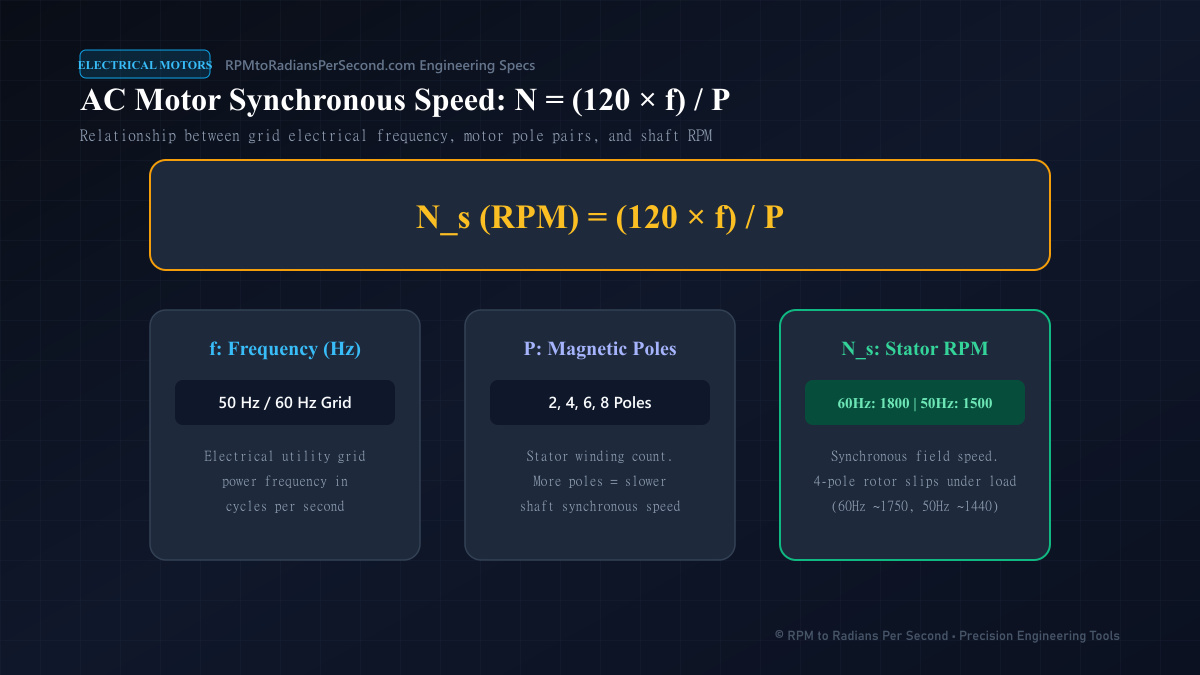
The synchronous speed formula calculates the rotating stator magnetic field:
N_s = (120 × f) / p = (120 × 60) / 2 = 3600 RPMWhere:
- f is the electrical line frequency (60 Hz).
- p is the number of electromagnetic stator poles (2 poles).
- 120 is the standard dimensional constant.
Because a 2-pole motor contains only one pair of north-south poles, the magnetic field completes a full 360-degree mechanical rotation for every single electrical cycle. For a broader overview of synchronous versus asynchronous baselines, visit our guide on standard motor RPMs.
| Machine Type | Operating Condition | Shaft Speed (RPM) | Angular Velocity (rad/s) |
|---|---|---|---|
| 2-Pole Synchronous Generator | 60 Hz grid tie | 3,600 RPM | 120π rad/s ≈ 376.99 rad/s |
| NEMA Design B 2-Pole Motor | Full load (approx. 2.8% slip) | 3,500 RPM | 116.67π rad/s ≈ 366.52 rad/s |
| High-Pressure Boiler Feed Pump | Direct coupled | 3,550 RPM | 118.33π rad/s ≈ 371.76 rad/s |
| Direct-Drive Industrial Turbo Blower | Unloaded baseline | 3,600 RPM | 120π rad/s ≈ 376.99 rad/s |
Mathematical Derivation: Converting 3600 RPM to rad/s
The standard conversion factor between revolutions per minute and radians per second is π / 30. This conversion standard adheres to the physical definitions published by the NIST Guide to SI Units.
The derivation proceeds through dimensional cancellation:
- One revolution equals an angle of
2πradians. - One minute equals
60seconds. - Combining terms gives the ratio:
(2π rad) / (60 s) = π / 30 rad/s per RPM.
Multiplying this factor by 3,600 RPM yields:
ω = 3,600 × (π / 30) = (3,600 / 30) × π = 120π rad/sCarrying out the multiplication with high-precision π:
120 × 3.1415926535... ≈ 376.991118 rad/sIf you need the step-by-step unit cancellation proof and inverse calculations, explore our core tutorial on rpm to radians per second.
Peripheral Surface Velocity at 3600 RPM
Because 3,600 RPM yields a high angular velocity of 377 rad/s, peripheral surface speeds mount quickly even on compact rotors. Engineers apply the tangential velocity relation:
v = r × ωWhere:
- v is linear surface speed in meters per second (m/s).
- r is the component radius in meters (m).
- ω is rotational speed in radians per second (rad/s).
Here is how linear surface speeds scale across typical rotor and impeller diameters spinning at 3,600 RPM:
| High-Speed Component | Outer Diameter | Tip Radius (r) | Linear Velocity (m/s) | Surface Speed (ft/min) | Rim Velocity (km/h) |
|---|---|---|---|---|---|
| Small Motor Shaft Journal | 50 mm (0.05 m) | 0.025 m | 9.42 m/s | 1,855 SFM | 33.93 km/h |
| Compact Pump Impeller | 150 mm (0.15 m) | 0.075 m | 28.27 m/s | 5,565 SFM | 101.79 km/h |
| High-Speed Turbine Disk | 300 mm (0.30 m) | 0.150 m | 56.55 m/s | 11,132 SFM | 203.58 km/h |
| Woodworking Shaper Cutter | 100 mm (0.10 m) | 0.050 m | 18.85 m/s | 3,710 SFM | 67.86 km/h |
On a 300 mm turbine disk spinning at 3,600 RPM, the outer rim velocity surpasses 200 kilometers per hour. To understand how centrifugal acceleration and tangential speeds correlate with diameter, inspect our in-depth resource on rpm to linear velocity.
Torque and Mechanical Power at 3600 RPM
High-speed machines generate substantial horsepower despite moderate shaft torque. In the SI system, power equals torque multiplied by angular velocity:
P = τ × ωWhere:
- P is mechanical output power in Watts (W).
- τ is torque in Newton-meters (N·m).
- ω is rotational shaft velocity in radians per second (rad/s).
Rearranging for torque demonstrates why high-speed shafts can be sized with smaller cross-sections:
τ = P / ω = 75,000 W / 376.991 rad/s ≈ 198.94 N·mA 100 HP (75 kW) motor running at 3,600 RPM requires under 200 N·m of torque. By comparison, an 1,800 RPM motor producing the same power requires nearly 400 N·m of torque, demanding a much thicker shaft. To compare imperial horsepower ratings with shaft torque values, consult our reference on rpm and torque to horsepower.
Frequency and Electrical Cycles
Because 3,600 RPM equals 376.99 rad/s, calculating rotational frequency in Hertz requires dividing by 60 seconds:
f_rot = 3,600 RPM / 60 s = 60 HzA 3,600 RPM rotor completes exactly 60 mechanical revolutions every second. In a 2-pole AC generator, this mechanical frequency translates directly into a 60 Hz electrical waveform. For an in-depth exploration of electrical frequency versus mechanical shaft speed, read our analysis on rpm to hz.
Code Implementations for Engineers
Simulation algorithms and flight controllers frequently compute angular velocity in real time. Academic engineering courses, including curriculum materials from MIT OpenCourseWare, stress using high-precision constants to avoid floating-point drift.
Python Code
import math

def convert_3600_rpm_to_rad_s() -> float:
    rpm = 3600.0
    return rpm * (math.pi / 30.0)

angular_velocity = convert_3600_rpm_to_rad_s()
print(f"Angular Velocity: {angular_velocity:.6f} rad/s") # Output: 376.991118 rad/s
MATLAB / Octave
rpm = 3600;
omega = rpm * (pi / 30);
fprintf('Angular Velocity: %.6f rad/s\n', omega);
For broader mathematical vector transformations and kinematic equations, explore our foundational angular velocity guide.
Frequently Asked Questions
What is 3600 RPM in radians per second?
3600 RPM equals exactly 120π rad/s, which evaluates to approximately 376.991118 radians per second.
Why do 2-pole AC motors spin at 3600 RPM?
On a 60 Hz electrical grid, synchronous speed is (120 × 60) / 2 = 3600 RPM. Because the stator has two poles, the magnetic field completes a full mechanical revolution with every electrical cycle.
What is the formula to convert 3600 RPM to rad/s?
Multiply 3,600 by π and divide by 30: 3600 × (π / 30) = 120π rad/s ≈ 376.99 rad/s.
How does 3600 RPM compare to 1800 RPM in angular velocity?
3,600 RPM equals 376.99 rad/s, exactly twice the angular velocity of an 1,800 RPM motor (188.50 rad/s). Because centripetal acceleration scales with the square of angular velocity, centrifugal forces quadruple.
What is the linear speed of a 6-inch rotor at 3600 RPM?
A 6-inch diameter rotor has a 3-inch (0.0762 meter) radius. Multiplying 0.0762 m by 376.991 rad/s yields a surface rim speed of 28.73 meters per second, or roughly 5,655 surface feet per minute.
Ready to run the numbers?
Get your result instantly — private, in your browser.