What is Angular Velocity? A Complete Guide
A practical guide to angular velocity. Learn what it is, how it differs from linear velocity, and why it is universally measured in radians per second.
Physics class has a funny way of making simple concepts feel incredibly complicated. You understand what speed is—how fast something moves from point A to point B. But the moment an object starts spinning, the textbook introduces a flurry of Greek letters and a brand new term: angular velocity. Suddenly, you are expected to calculate how fast an angle is changing, and you are terrified of failing the midterm.
Take a deep breath. The math here is entirely manageable. Let's break down exactly what angular velocity is and why we use radians per second (rad/s) to measure it, with no unnecessarily dense jargon.
The Definition of Angular Velocity
In the simplest possible terms, angular velocity is just the rate at which an object rotates.
Imagine you drew a dot on the outer edge of a spinning bicycle wheel. As the wheel turns, that dot sweeps through an angle. Angular velocity tells you exactly how large that swept angle is for every second that ticks by. It is a fundamental concept in rotational kinematics.
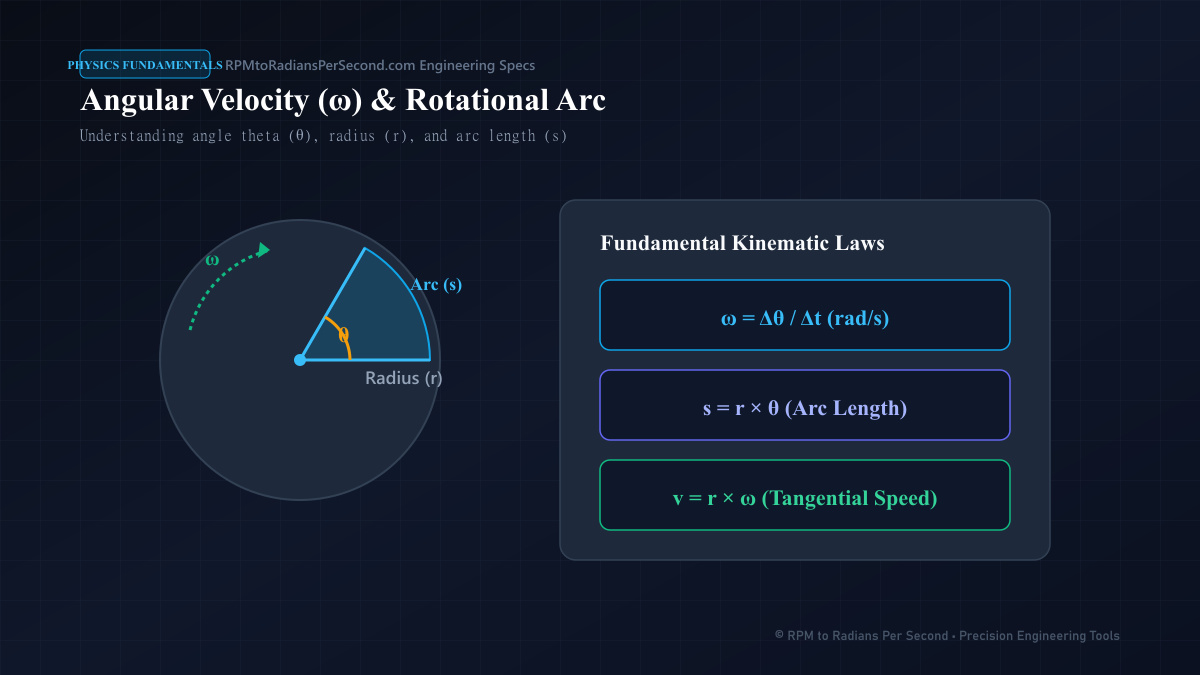
Mathematically, average angular velocity is represented by the Greek letter omega (ω). It is calculated by taking the change in angle (Δθ) and dividing it by the change in time (Δt):
ω = Δθ / ΔtUnits of Measurement: Why Radians Per Second?
When talking about car engines or standard motors, you usually hear rotational speed expressed in Revolutions Per Minute (RPM). RPM is a perfectly fine, human-friendly unit.
When you step into a physics lab, the standard SI unit switches to radians per second (rad/s). Radians represent a natural mathematical measure where a full circle is defined as exactly 2π radians. According to the National Institute of Standards and Technology (NIST) and the BIPM SI Brochure, radians are preferred in physics because they are dimensionless pure geometric ratios.
When you master the rpm to radians per second formula, you unlock the ability to seamlessly connect rotational motion to linear motion.
Angular Velocity vs. Linear Velocity
It is crucial to understand the difference between these two concepts before your next exam.
| Feature | Angular Velocity (ω) | Linear Velocity (v) |
|---|---|---|
| Definition | Rate of change of the swept angle. | Rate of change of physical position through space. |
| Units | rad/s (or RPM, °/s) | m/s, km/h, mph |
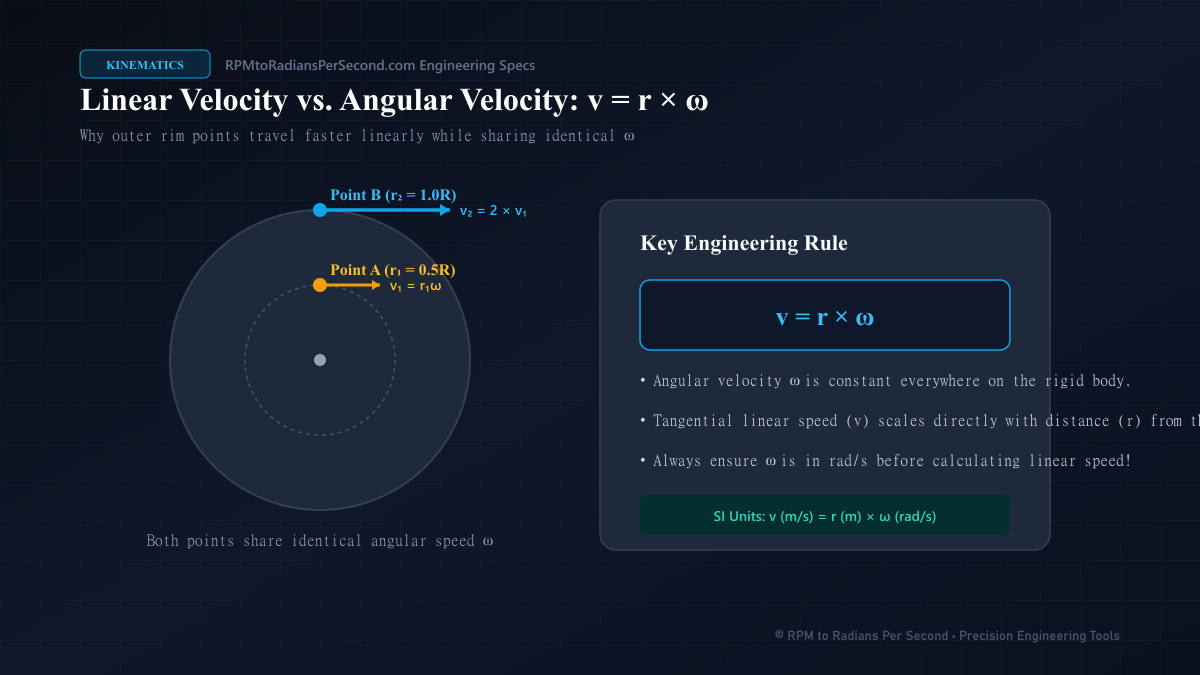
| Consistency | Identical for every point on a rigid spinning object. | Increases as distance from the center (radius) increases. |
| Example | A record player spinning at 33 ⅓ RPM. | A bug on the edge of the record traveling at 0.5 m/s. |
| Reverse Math | Use radians per second to rpm. | Use v / r to find ω. |
- Angular Velocity (ω): This is identical for every single point on a rigid spinning object. A sticker near the center of a record player and a sticker on its outer edge both complete one full rotation in the exact same amount of time. They share the same angular velocity.
- Linear Velocity (v): This depends entirely on distance from the center. The sticker on the outer edge has to travel a much larger circle than the sticker near the center. Because both complete their circles in the same time, the outer sticker is physically moving faster through space.
| Point on Record | Distance from Center (r) | Angular Velocity (ω) | Linear Velocity (v = rω) |
|---|---|---|---|
| Inner Sticker | 0.05 meters | 3.49 rad/s | 0.1745 m/s |
| Middle Sticker | 0.10 meters | 3.49 rad/s | 0.3490 m/s |
| Outer Sticker | 0.15 meters | 3.49 rad/s | 0.5235 m/s |
For an interactive tool that translates any shaft rotation and radius into ground or surface velocity, visit our dedicated rpm to linear velocity guide. Furthermore, when rotational velocity generates extreme outward forces, laboratories calculate centrifuge rpm to rcf, while engine builders calculate mechanical output using our rpm and torque to horsepower guide.
Rotational Kinetic Energy and Moment of Inertia
Angular velocity is also the cornerstone of rotational energy calculations in mechanical physics. Just as a mass moving linearly possesses kinetic energy (), a rotating body stores mechanical energy within its spinning mass.
The fundamental formula for rotational kinetic energy is:
E_rot = 0.5 × I × ω²Where:
- E_rot is rotational kinetic energy measured in Joules (J).
- I is the mass moment of inertia measured in kilogram-meters squared (kg·m²).
- ω is the angular velocity measured in radians per second (rad/s).
Because angular velocity is squared in this relationship, doubling a rotor's rotational speed quadruples its stored energy. This dynamic explains why high-speed flywheels in electric grid storage systems require carbon-composite containment shields. If you need to step down rotational speed while amplifying output torque, check our gear ratio rpm calculator.
The Vector Nature of Angular Velocity (Right-Hand Rule)
While introductory physics problems treat angular velocity as a simple numerical speed, it is fundamentally a vector quantity. Angular velocity possesses both magnitude and directional orientation along the axis of rotation.
To determine the vector's direction, physicists utilize the classic right-hand rule:
- Curl the fingers of your right hand in the direction of the object's physical rotation.
- Extend your thumb perpendicular to your curled fingers along the rotational axis.
- Your thumb points in the true direction of the angular velocity vector (ω).
For a wheel spinning counterclockwise in the XY-plane, the angular velocity vector points directly outward along the positive Z-axis. This vector orientation is critical for predicting gyroscopic precession in aerospace navigation and motorcycle countersteering dynamics.
Applications in the Real World
Angular velocity is not just textbook theory. It is the foundation of modern engineering, as taught in university engineering programs worldwide:
| Industry | How Angular Velocity is Used | Example Target Speed |
|---|---|---|
| Robotics | Calculating exact joint rotation speeds for smooth movements. | 10 rad/s |
| Automotive | Determining engine RPMs and transmission gear ratios. | 314 rad/s (~3,000 RPM) |
| Aerospace | Maintaining precise satellite trajectories in geosynchronous orbit. | 7.29e-5 rad/s |
By mastering the concept of angular velocity and keeping your units straight, you are well on your way to understanding the mechanics of a spinning universe. If you run into a confusing spec like 120 RPM, you will know exactly what it means.
Frequently Asked Questions
1. What is the symbol for angular velocity?
The standard symbol for angular velocity in physics and engineering is the lowercase Greek letter omega (ω).
2. Is angular velocity a vector or a scalar?
Angular velocity is a vector quantity, meaning it has both a magnitude (speed) and a direction. The direction is determined by the right-hand rule: if you curl the fingers of your right hand in the direction of rotation, your thumb points in the direction of the angular velocity vector.
3. How do you find angular velocity from RPM?
To find angular velocity in rad/s from an RPM value, multiply the RPM by the exact fraction π/30.
4. Does angular velocity change with radius?
No. For a rigid, spinning object, the angular velocity is identical at every single point on that object, regardless of the radius. The linear velocity, however, will increase as you move further away from the center of rotation.
5. What are the standard units of angular velocity?
In the International System of Units (SI), angular velocity is measured in radians per second (rad/s). In machinery and automotive applications, it is commonly measured in Revolutions Per Minute (RPM).
Ready to convert your units without the headache? Explore our interactive conversion library to instantly switch between RPM, rad/s, Hertz, and degrees per second with absolute precision.
Ready to run the numbers?
Get your result instantly — private, in your browser.