1800 RPM to Rad/s: Exact Math & Motor Speed Guide
Convert 1800 RPM to radians per second (60π rad/s). Learn why 4-pole AC induction motors and 60 Hz electrical grids operate at this synchronous speed.
If you are staring at a motor specification sheet or working through a tough dynamics problem, converting 1,800 RPM into radians per second feels urgent. You do not have time to re-derive rotational kinematics from scratch while deadlines loom. The exact conversion for 1800 RPM to rad/s is 60π rad/s, which equals approximately 188.49556 rad/s. Here is the complete engineering breakdown.
The exact conversion for 1800 rpm to rad/s simplifies to 60π rad/s.
If your simulation software or scientific calculator requires a decimal representation, that evaluates to 188.495559 rad/s. You can calculate intermediate values instantly using the interactive tool below, or explore our full library of standard motor speeds in the conversions directory:
Why 1800 RPM Dominates Industrial Machinery
Across North America and territories utilizing a 60 Hz electrical grid, 1,800 RPM is the single most prevalent motor speed designation. When you inspect pumps, industrial blowers, air compressors, or factory conveyors, the nameplate almost always references either 1,800 RPM or its slip-adjusted equivalent.
This prevalence originates from the physics of AC induction machinery governed by standards from organizations like the National Electrical Manufacturers Association (NEMA) and technical literature from the IEEE. In an alternating current power distribution system, rotational magnetic fields generate torque at speeds locked to line frequency.
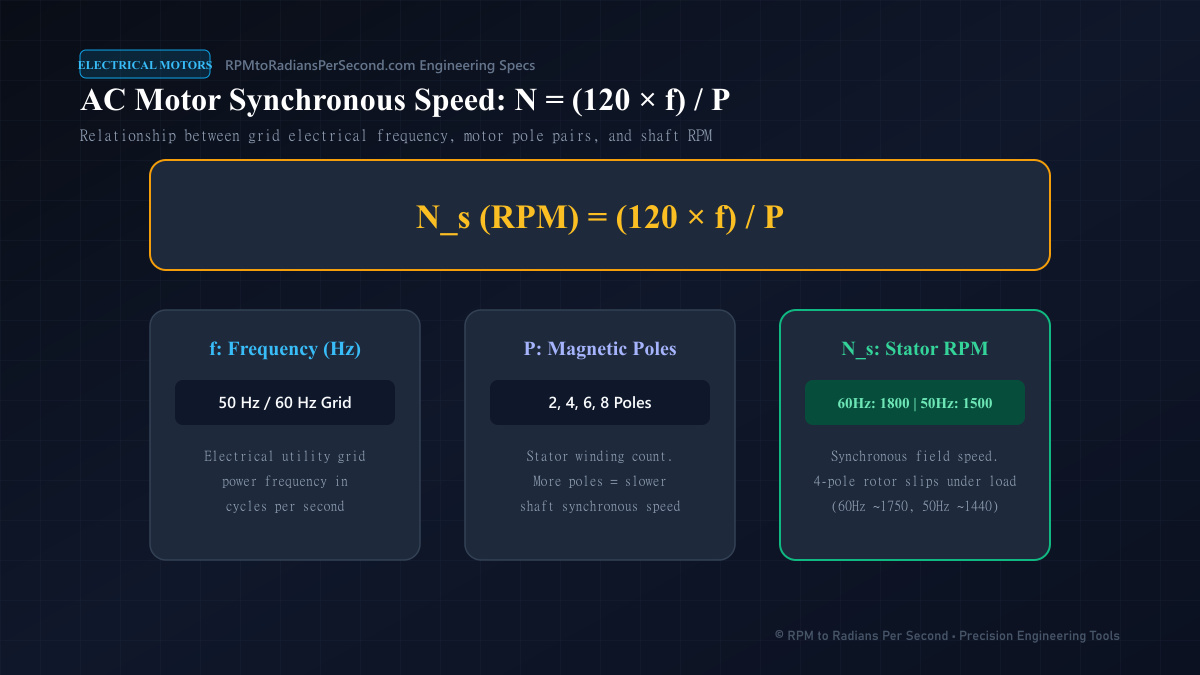
The synchronous speed formula calculates theoretical shaft velocity without mechanical load:
N_s = (120 × f) / p = (120 × 60) / 4 = 1800 RPMWhere:
- f is the electrical line frequency (60 Hz in North America).
- p is the total number of stator electromagnetic poles (4 poles).
- 120 is the mathematical constant converting seconds to minutes while factoring two pole pairs.
Because a 4-pole configuration strikes an ideal balance between physical frame size, copper winding volume, and shaft torque, manufacturers adopted it as the standard industrial workhorse. To understand how pole counts dictate base speeds across alternate configurations, review our detailed guide on standard motor RPMs.
| Motor Type | Operating Condition | Shaft Speed (RPM) | Angular Velocity (rad/s) |
|---|---|---|---|
| Synchronous 4-Pole AC Motor | No-load theoretical | 1,800 RPM | 60π rad/s ≈ 188.50 rad/s |
| Typical NEMA Design B Induction Motor | Full-load nameplate (approx. 3% slip) | 1,745 RPM | 58.17π rad/s ≈ 182.74 rad/s |
| High-Efficiency Inverter-Duty Motor | 60 Hz base speed (approx. 2.2% slip) | 1,760 RPM | 58.67π rad/s ≈ 184.31 rad/s |
| Heavily Loaded Induction Motor | High-slip crane duty (approx. 5% slip) | 1,710 RPM | 57.00π rad/s ≈ 179.07 rad/s |
Step-by-Step Mathematical Derivation
To convert any rotational speed from revolutions per minute into the International System of Units (SI) angular velocity unit, multiply by π / 30. This fundamental factor originates directly from the SI definitions published by the NIST Guide to the SI.
The derivation breaks down into elementary dimensional fractions:
- One full revolution encompasses an angular displacement of
2πradians. - One minute encompasses exactly
60seconds. - Dividing angular displacement by time yields:
(2π rad) / (60 s) = π / 30 rad/s per RPM.
Now substitute 1,800 RPM into the dimensional relationship:
ω = 1,800 × (π / 30) = (1,800 / 30) × π = 60π rad/sMultiplying 60 by the mathematical constant π provides:
60 × 3.1415926535... ≈ 188.495559 rad/sFor complete algebraic proofs and reciprocal conversion mechanics, consult our comprehensive resource on rpm to radians per second.
Calculating Tangential Surface Speed at 1800 RPM
When 1,800 RPM drives a drive pulley, grind wheel, or vehicle axle, rotational velocity translates into physical surface travel speed. Engineers calculate this rim velocity using the fundamental kinematics relation:
v = r × ωWhere:
- v represents linear velocity in meters per second (m/s).
- r represents the radius in meters (m).
- ω represents angular velocity in radians per second (rad/s).
Because our angular velocity is precisely 60π rad/s, calculating surface velocity across typical industrial pulley and blade diameters becomes straightforward arithmetic:
| Rotating Component | Diameter | Radius (r) | Linear Speed (m/s) | Surface Speed (ft/min) | Velocity (km/h) |
|---|---|---|---|---|---|
| Small Sheave Pulley | 100 mm (0.10 m) | 0.05 m | 9.42 m/s | 1,855 SFM | 33.93 km/h |
| Bench Grinder Wheel | 200 mm (0.20 m) | 0.10 m | 18.85 m/s | 3,710 SFM | 67.86 km/h |
| Industrial Blower Impeller | 400 mm (0.40 m) | 0.20 m | 37.70 m/s | 7,421 SFM | 135.72 km/h |
| Circular Saw Blade | 305 mm (0.305 m) | 0.1525 m | 28.75 m/s | 5,658 SFM | 103.48 km/h |
Notice that on a 200 mm grinding wheel spinning at 1,800 RPM, the abrasive edge travels at nearly 68 kilometers per hour. For detailed engineering derivations connecting rim radius directly to travel distance, refer to our guide on rpm to linear velocity.
Torque and Mechanical Power at 1800 RPM
Angular velocity in radians per second represents the vital link connecting rotational torque to mechanical power. While imperial equations rely on confusing empirical constants like 5,252, SI physics formulas operate with elegant clarity:
P = τ × ωWhere:
- P is mechanical power measured in Watts (W).
- τ is shaft torque measured in Newton-meters (N·m).
- ω is angular velocity in radians per second (rad/s).
At 1,800 RPM, substituting ω = 188.50 rad/s reveals that a standard 10 kW motor delivers:
τ = 10,000 W / 188.496 rad/s ≈ 53.05 N·mIf you need to convert imperial horsepower and foot-pounds into metric torque values for dynamometer analysis, review our reference on rpm and torque to horsepower.
Gear Reduction Scenarios for 1800 RPM Motors
Direct-drive 1,800 RPM motors frequently spin too quickly for heavy material handling, hoists, and agitators. Mechanical gearboxes reduce output shaft speed while multiplying available torque.
To size a gearbox stepping 1,800 RPM down to lower operating speeds:
- Target Output: 60 RPM
- Required Gear Ratio:
1800 / 60 = 30:1 - Target Output: 120 RPM
- Required Gear Ratio:
1800 / 120 = 15:1
A 30:1 speed reducer reduces shaft angular velocity from 188.50 rad/s down to 6.28 rad/s while multiplying shaft torque thirty-fold, discounting gear meshing friction. To configure multi-stage planetary or helical reductions, explore our gear ratio rpm calculator.
Programming & Simulation Formulas
Software developers modeling physics in game engines, robotics controllers, or numerical simulations must execute this conversion inside tight loops. Educational physics resources, including course materials from MIT OpenCourseWare, emphasize maintaining high numerical precision to avoid compounding rounding errors.
Python Implementation
import math

def rpm_to_rad_per_sec(rpm: float) -> float:
    # Use math.pi / 30 for exact analytical precision
    return rpm * (math.pi / 30.0)

speed_rpm = 1800.0
omega = rpm_to_rad_per_sec(speed_rpm)
print(f"Angular Velocity: {omega:.6f} rad/s") # Output: 188.495559 rad/s
Excel / Google Sheets Formula
=A1 * (PI() / 30)
Where cell A1 contains 1800.
To explore broader vector kinematics and rotation matrices, read our complete angular velocity guide.
Frequently Asked Questions
What is 1800 RPM in radians per second?
1800 RPM equals exactly 60π rad/s, which is approximately 188.495559 radians per second.
Why does an 1800 RPM motor only show 1750 RPM on the nameplate?
Standard AC induction motors experience rotor slip under mechanical load. While the stator magnetic field rotates synchronously at 1,800 RPM, the rotor lags slightly behind at approximately 1,750 RPM to generate torque.
How do you convert 1800 RPM to rad/s manually?
Multiply 1,800 by π and divide the result by 30. Because 1,800 divided by 30 equals 60, the exact product is 60π rad/s, or roughly 188.50 rad/s.
What is the linear speed of an 8-inch blade spinning at 1800 RPM?
An 8-inch diameter blade has a 4-inch (0.1016 meter) radius. Multiplying this radius by 188.496 rad/s yields a rim velocity of 19.15 meters per second, or approximately 3,770 surface feet per minute.
What is the frequency in Hertz of an 1800 RPM shaft?
Divide 1,800 RPM by 60 seconds to calculate rotational frequency: 1,800 / 60 = 30 Hz. The shaft completes 30 full mechanical rotations every second.
Ready to run the numbers?
Get your result instantly — private, in your browser.