Radians Per Second to RPM: The Ultimate Reverse Guide
Convert radians per second to RPM. Learn the exact 30/π reverse multiplier, avoid decimal drift, understand motor sizing, and use our free calculator.
You have finally solved the brutal physics equation, and your isolated angular velocity is sitting right there on your paper: 100 rad/s. You are feeling great. But then the assignment (or your engineering lead) demands the final answer in Revolutions Per Minute (RPM) so they can actually go buy the right motor from a catalog. How do you cross the bridge from the sterile world of theoretical physics back into the messy mechanical world?
To convert radians per second to rpm, you simply multiply your theoretical answer by the exact fraction 30/π.
If you are just trying to get a quick number to order a part, drop your rad/s value into the calculator below to get the precise RPM answer instantly.
If you want to understand the deep mechanics behind this reverse conversion, how it applies to motor sizing, and how to write the code to automate it without causing a catastrophic gear failure, keep reading.
The Math: Why the Reverse Multiplier is 30/π
If you have already read our pillar guide on converting RPM to radians per second, you know the forward multiplier is π/30. According to fundamental algebraic rules taught by the American Mathematical Society (AMS), to reverse a multiplication process, you multiply by the reciprocal. You simply flip the fraction upside down.
But let's break down the logic from scratch if you need to show your work on an exam:
- Seconds to Minutes (Time): Your starting rate is "per second," but you need "per minute." Because there are 60 seconds in a minute, you multiply your rad/s by 60.
- Radians to Revolutions (Distance): A single full revolution is defined as exactly 2π radians. To find out how many full revolutions fit into your radian value, you divide by 2π.
- Combine the Math: Multiplying by 60 and dividing by 2π cleanly simplifies to multiplying by
30/π.
RPM = rad/s × (30 / π)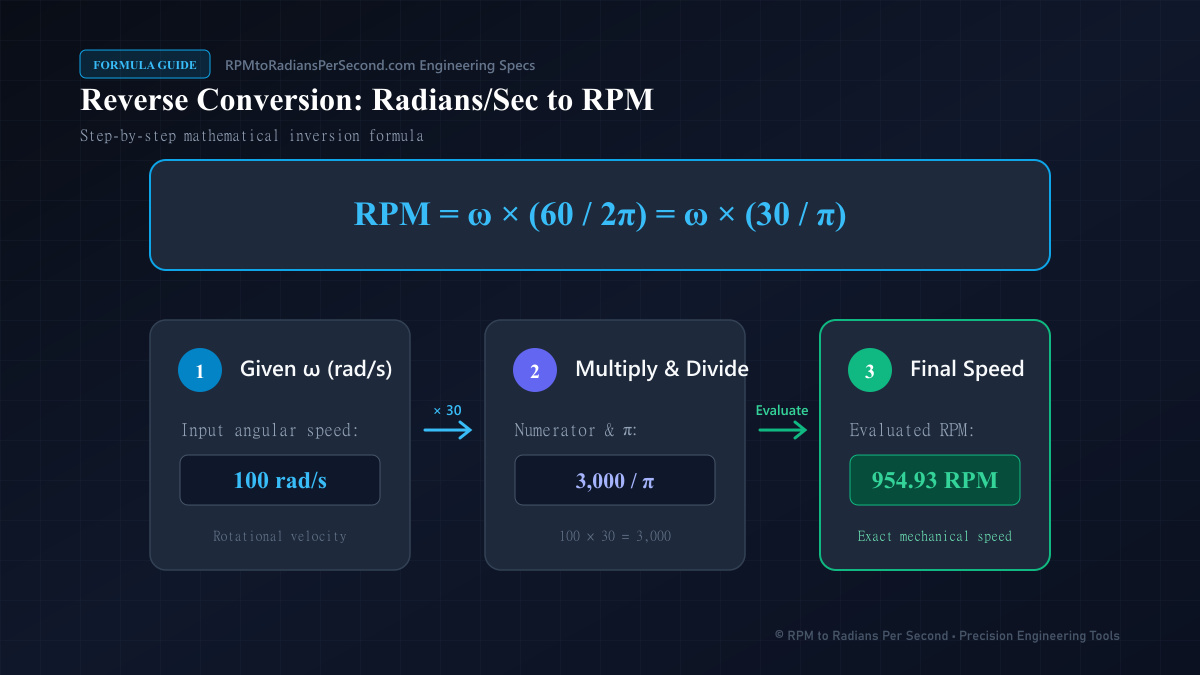
Running the Real-World Numbers
Let's assume your CAD software output an angular velocity requirement of exactly 50 rad/s. You need to hit a hardware catalog to find a standard AC motor that matches that speed.
- Take your target: 50 rad/s
- Multiply by the exact fraction:
50 × (30 / π) - Find the exact answer:
1500 / π RPM - Calculate the usable decimal: Approximately 477.46 RPM
Now you know exactly what RPM specification to filter for when browsing industrial catalogs like McMaster-Carr or Grainger.
Quick Reverse Conversion Table
If you are dealing with common rad/s outputs from physics simulators, use this table to quickly find the exact or approximate RPM.
| Simulated rad/s | Exact Math | Exact RPM | Approx Decimal (RPM) |
|---|---|---|---|
| 1 | 1 × (30/π) | 30/π | 9.55 |
| 10 | 10 × (30/π) | 300/π | 95.49 |
| 4π (12.57) | 4π × (30/π) | 120 | 120.00 |
| 50 | 50 × (30/π) | 1500/π | 477.46 |
| 100 | 100 × (30/π) | 3000/π | 954.93 |
| 100π (314.16) | 100π × (30/π) | 3000 | 3000.00 |
Notice how 4π perfectly translates to 120 RPM, a foundational speed for AC synchronous motors on a 60Hz grid. When the Pi cancels out, you are usually looking at a standard catalog speed.
Sizing Motors and Dealing with Gear Reduction
The reality of mechanical engineering is that you will almost never find an off-the-shelf motor that spins at exactly the RPM you calculated from your physics equation.
If your software demands an output of exactly 10 rad/s (roughly 95.5 RPM), you will quickly find that most standard electric motors run much faster—usually around 1,500 or 3,000 RPM.
This is where gear reduction comes in.
- Calculate Target RPM: Convert your 10 rad/s to 95.5 RPM.
- Select Standard Motor: Choose an off-the-shelf motor, for example, 1,500 RPM.
- Find the Gear Ratio: Divide the motor speed by your target speed (
1500 / 95.5 = ~15.7). - Select Gearbox: You would need a gearbox with roughly a 15.7:1 reduction ratio to turn the motor's high speed into the exact 10 rad/s output your simulation demands. You can compute exact teeth pairings using our gear ratio rpm calculator.
| Target rad/s | Target RPM | Chosen Motor RPM | Required Gear Ratio |
|---|---|---|---|
| 5 | 47.75 | 1000 | ~21:1 |
| 10 | 95.49 | 1500 | ~15.7:1 |
| 20 | 190.99 | 1500 | ~7.85:1 |
| 50 | 477.46 | 3000 | ~6.28:1 |
| 100 | 954.93 | 3000 | ~3.14:1 |
Without the radians per second to rpm conversion, sizing that gearbox is impossible.
Coding the Reverse Conversion
If you are building a tool that takes theoretical physics data and outputs mechanical specs, you need to code this conversion precisely.
Python:
import math

def rads_to_rpm(rads):
    # Uses math.pi to prevent early rounding drift
    return rads * (30 / math.pi)

# Example usage
target_velocity = 100
required_rpm = rads_to_rpm(target_velocity)
print(f"Required Motor Speed: {required_rpm} RPM")
JavaScript:
function radsToRpm(rads) {
    // Uses Math.PI for maximum floating point accuracy
    return rads * (30 / Math.PI);
}

// Example usage
const targetVelocity = 100;
const requiredRpm = radsToRpm(targetVelocity);
console.log(`Required Motor Speed: ${requiredRpm} RPM`);
Converting rad/s to Hertz (Hz)
Sometimes, hardware doesn't use RPM; it just requires plain old frequency in Hertz (Hz), the standard SI unit of frequency defined by the BIPM. Remember that Hertz is simply revolutions per second.
If you have your angular velocity in rad/s, converting it to Hz is even simpler than going to RPM. Because one revolution is 2π radians, you just divide your rad/s by 2π, or reference our rpm to hz conversion guide.
Hz = rad/s / (2π)
For example, a common angular velocity of 314 rad/s (roughly 100π) converts to 50 Hz, which is the standard grid frequency in Europe and much of the world.
Frequently Asked Questions
1. What is the exact multiplier to convert rad/s to RPM?
The exact mathematical multiplier is 30/π. Multiply your radians per second value by 30 and then divide by π to find the exact RPM without any rounding errors.
2. Is multiplying by 9.55 the same as using 30/π?
No. 9.55 is a severely rounded decimal approximation of 30/π. Using it is acceptable for a quick mental estimate on a whiteboard, but it will inject compounding rounding errors into any precision engineering calculations or code.
3. How do you find Hertz from radians per second?
To convert radians per second to Hertz (revolutions per second), divide your rad/s value by exactly 2π.
4. Why would I need to convert rad/s back to RPM?
While physics calculations and rotational simulations run natively on rad/s, physical hardware (motors, engines, hard drives) is universally rated and cataloged in RPM. You must convert your theoretical output into RPM to purchase the correct mechanical parts.
5. Does the reverse formula apply to any object?
Yes. The conversion between rad/s and RPM is purely mathematical. It applies universally to any spinning object, whether it is an industrial wind turbine or a bicycle wheel.
6. What if my rad/s value has Pi in it?
This is the best-case scenario! If your value is, for example, 4π rad/s, the Pi in your value and the Pi in the denominator of the multiplier (30/π) will cancel each other out perfectly. 4π × (30/π) = 120.
7. What is 1 rad/s in RPM?
1 rad/s is exactly 30/π RPM, which calculates to approximately 9.549 RPM.
8. Are there any other units of angular velocity?
Yes, degrees per second (°/s) is sometimes used for visual simulations (like video games), and Gradians per second is used in very niche land surveying applications, but rad/s and RPM remain the undisputed kings of physics and engineering.
9. Can I use this formula to find linear speed?
No. To find linear speed, you must use rad/s, not RPM. If you have RPM, convert it to rad/s first, then multiply by the radius (v = r * ω), as detailed in our rpm to linear velocity guide.
10. Why don't catalogs just list motors in rad/s?
The mechanical engineering industry standardized on RPM over a century ago because whole numbers (like 1,500 RPM) are much easier for human technicians to read, stamp on metal plates, and verify with strobe tachometers than messy irrational numbers like 157.08 rad/s.
Tired of calculating 30/π by hand? Skip the algebraic drift. Bookmark our exact Radians Per Second to RPM Calculator to instantly get your reverse conversions with zero rounding errors every single time.
Ready to run the numbers?
Get your result instantly — private, in your browser.